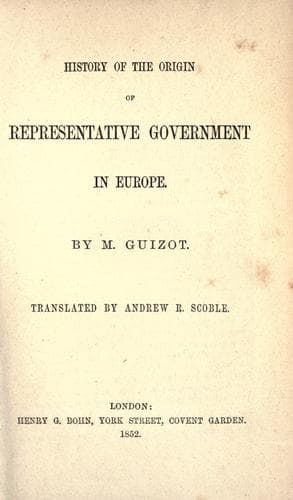
History of the Origin of Representative Government in EuropeGuizot, François
History
History of the Origin of Representative Government in Europe
Guizot, François
Europe -- History; Representative government and representation
Such are the facts: they demonstrate the phenomenon which I
indicated at the outset, namely, the destruction of the middle
class in the empire; it was destroyed materially by the ruin and
dispersion of the curials, and morally by the denial of all
influence to the respectable population in the affairs of the
State, and eventually in those of the city. Hence it arose that,
in the fifth century, there was so much uncultivated land and so
many towns almost deserted, or inhabited only by a famished and
spiritless population. The system which I have just explained
contributed, much more powerfully than the devastations of the
Barbarians, to produce this result.
In order rightly to apprehend the true character and consequences
of these facts, we must reduce them to general ideas, and deduce
therefrom all that they contain in regard to one of the greatest
problems of social order. Let us first examine them on the
relations of the municipal system with political order, of the
city with the State. In this respect, the general fact which
results from those which I have stated, is the absolute
separation of political rights and interests from municipal
rights and interests; a separation equally fatal to the political
rights and interests, and to the municipal rights and interests
of citizens. So long as the principal citizens possessed, at the
centre of the State, real rights and an actual influence, the
municipal system was not wanting in guarantees of security, and
continued to develop itself. As soon as the principal citizens
lost their influence at head quarters, these guarantees
disappeared, and the decay of the municipal system was not long
in manifesting itself.
{201}
The Roman Empire And Modern States.
Let us now compare the course of things in the Roman world, with
what has occurred in the modern states. In the Roman world,
centralization was prompt and uninterrupted. In proportion as she
conquered the world, Rome absorbed and retained within her walls
the entire political existence of both victors and vanquished.
There was nothing in common between the rights and liberties of
the citizen, and the rights and liberties of the inhabitant;
political life and municipal life were not confounded one in the
other, and were not exhibited in the same localities. In regard
to politics, the Roman people had, in truth, only one head; when
that was stricken, political life ceased to exist; local
liberties then found themselves unconnected by any bond, and
without any common guarantee for their general protection.
Public-domain text, read in full here on John Shaqi.
Reviews
Reviews
No reviews yet
Be the first to share your thoughts on this work.
Elsewhere in the archive
Join the Discussion
Join the discussion
Sign in to leave a comment or review.
Sign InorCreate an account