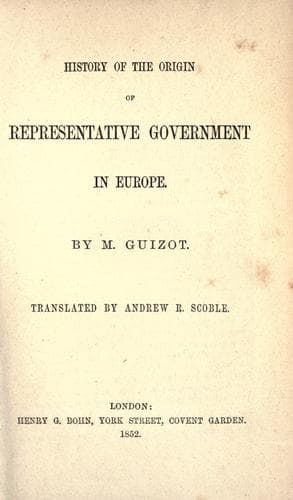
History of the Origin of Representative Government in EuropeGuizot, François
History
History of the Origin of Representative Government in Europe
Guizot, François
Europe -- History; Representative government and representation
10. Leovigild, from 570 to 586, consolidated and extended the
monarchy. He gained great victories over the Greco-Romans who
had recovered a part of Spain, and won from them
Medina-Sidonia, Cordova, and other towns. He also defeated the
Vascons [Footnote 16] who had maintained their independent
occupation of the country on both sides of the Pyrenees. In
586, he completely subdued the Suevi; he greatly extended the
royal power, made large confiscations of the property of the
church and the nobles, persecuted the Catholics, and convoked a
council of Arian bishops at Toledo, in 582, to endeavour to
explain Arianism in such a manner as to satisfy the people, and
to insure its general reception in his dominions. A civil war
broke out between Leovigild and his son Hermenegild, who was a
Catholic. After various vicissitudes, Hermenegild was taken,
confined at Seville in a tower which bears his name, and put to
death in 684. Before his insurrection, he was associated with
his father in the crown, as was also his brother Recared, who
governed the provinces in Gaul. Leovigild corrected and
completed the laws of Euric.
[Footnote 16: Probably the Basques of the present day. ]
{211}
Up to this period, there was no unity in the Visigothic
monarchy. General institutions were wanting. The national
assemblies were more irregular than in other countries. Neither
the principle of hereditary succession, nor that of election,
prevailed as regarded the kingly office. Out of fourteen kings,
six had been assassinated. There was no coherence among the
provinces of the kingdom. The clergy were deeply divided
amongst themselves. The king gave a factitious preponderance to
the Arian minority.
Reign Of Recared.
11. In 586, Recared I. succeeded Leovigild, declared himself a
Catholic, and convoked the third general council of Toledo, in
587. A union was effected between the royal and ecclesiastical
authority. Recared found himself in a position somewhat
analogous to that of Constantine the Great, after his
conversion to Christianity. He was energetically supported by
the Catholic clergy, whom he, in his turn, as zealously
maintained. At the third council of Toledo, the two powers made
in common the laws of which they both had need. An important
fact should be noticed in the tenure of this council. During
the first three days the ecclesiastics sat alone, and regulated
religious affairs exclusively. On the fourth day, laymen were
admitted; and affairs both civil and religious were then
treated of.
Recared made war against the Franks of Gothic Gaul, and against
the Romans in Spain. This last war was terminated by the
intervention of Pope Gregory the Great, who negotiated a treaty
between the Emperor Maurice and Recared, the latter of whom,
since 590, had sent ambassadors to the Pope. The Arian clergy
excited several rebellions against Recared.
Public-domain text, read in full here on John Shaqi.
Reviews
Reviews
No reviews yet
Be the first to share your thoughts on this work.
Elsewhere in the archive
Join the Discussion
Join the discussion
Sign in to leave a comment or review.
Sign InorCreate an account