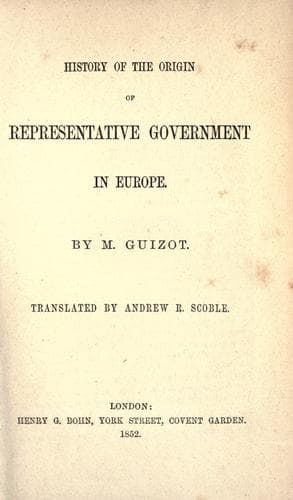
History of the Origin of Representative Government in EuropeGuizot, François
History
History of the Origin of Representative Government in Europe
Guizot, François
Europe -- History; Representative government and representation
Facts prove this. These councils of Toledo, whither usurpers came
to be elected, and which gave an entire code to the Visigoths,
exercised in fact, over the great events of this period in Spain,
less influence than was exerted in France by the _Champs de
Mars_ and _de Mai_. They occupied, but did not supply,
the place of the old Germanic assemblies, for they did not
possess their brute force, and were not in a position to
substitute for it any sufficient regular force. Spain was
indebted to them for a much better legislation than that
possessed by other Barbarian nations, and probably also, in their
daily practice, for a more enlightened and humane administration
of justice; but in vain do we seek to find therein the principle
of a great institution of liberty, and the characteristics of a
veritable resistance of absolute power. During the period which
now occupies our attention, the reigning power in the other
States founded by the Barbarians was force--disorderly,
capricious, and unsettled force, sometimes distributed amongst a
multitude of almost independent chieftains; sometimes
concentrated, for a brief space, and according to circumstances,
in the hands of one man, or of a brutal and transitory
aristocracy. No principle was acknowledged; no right was legal;
all was matter of fact, liberty as well as power; and the germs
of free institutions existed in the disorderly relations of these
independent or ill-united forces, although, to speak the truth,
liberty was nowhere visible. In Spain, and through the influence
of the clergy, the government undoubtedly assumed greater
generality and a more regular form; the laws afforded greater
protection to the weak; the administration paid more attention to
their condition; and there was less disorder and violence in
society at large. Broader and more elevated moral ideas
frequently governed the exercise of power. But, on the other
hand, power was constituted under a more absolute form; Roman
maxims prevailed over Germanic traditions; theocratic doctrines
lent their aid to the arbitrary power of the Barbarians. The
councils of Toledo modified and enlightened despotism, but did
not limit the exercise of power.
{234}
The Officium Palatinum.
Public-domain text, read in full here on John Shaqi.
Reviews
Reviews
No reviews yet
Be the first to share your thoughts on this work.
Elsewhere in the archive
Join the Discussion
Join the discussion
Sign in to leave a comment or review.
Sign InorCreate an account