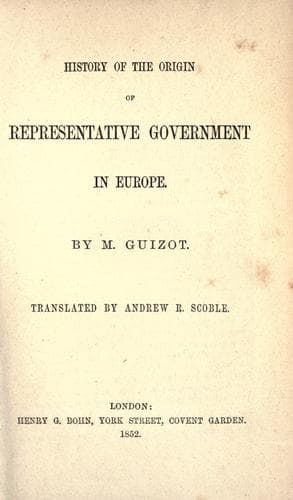
History of the Origin of Representative Government in EuropeGuizot, François
History
History of the Origin of Representative Government in Europe
Guizot, François
Europe -- History; Representative government and representation
It would therefore be vain to seek, in the Visigothic monarchy,
for the principles, or even the remnants, of any great
institution of liberty, or of any effectual limitation of power.
Neither the councils of Toledo, nor the _officium palatinum_
present this character; but there resulted from them something
that did not result from the _Champs de Mars_ and _de
Mai_, or from the Saxon Wittenagemot,--a code of laws, which,
for that period, are very remarkable for their large
philosophical views, their foresight, and their wisdom; but this
code, though it indicates the handiwork of enlightened
legislators, nowhere reveals the existence of a free people. It
contains even fewer germs or monuments of liberty than the rudest
of Barbarian laws; and the royal power, thus considered as in
itself the centre of the State, appears as much more absolute in
right, and much less limited in fact, than it was anywhere else.
An examination of the local institutions of the Visigoths will
lead us to the same result.
{237}
Local Institutions Of The Visigoths.
Local institutions are the most real, perhaps the only real,
institutions of Barbarian peoples. They do not possess sufficient
vitality or enlargement of mind to originate or preserve general
institutions. The material contiguity of individuals is an almost
indispensable condition of the existence of society amongst them;
it is therefore in the local institutions of the German peoples
that we must seek the history of their political life. The forms
of these institutions; and the modifications which they
underwent, exercised far greater influence over their destiny,
than the revolutions which occurred in central institutions, such
as the Wittenagemot, the _placita generalia_, and the royal
power.
As you have already seen, the laws of most of the German peoples
present three co-existent and conflicting systems: institutions
of liberty; institutions of territorial patronage, which gave
birth to feudalism; and monarchical institutions. The assembly of
free men transacting the general business, and administering
justice in every district; the landowners, exercising authority
and jurisdiction throughout their domains; the king's delegates,
whether dukes, counts, or others, also possessing authority and
jurisdiction: such are the three powers which have reciprocally
contested the government of localities, and whose existence and
vicissitudes are proved by the laws as well as by facts.
Public-domain text, read in full here on John Shaqi.
Reviews
Reviews
No reviews yet
Be the first to share your thoughts on this work.
Elsewhere in the archive
Join the Discussion
Join the discussion
Sign in to leave a comment or review.
Sign InorCreate an account