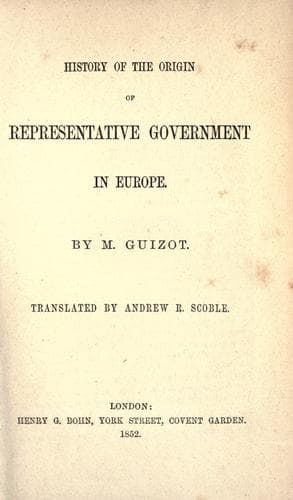
History of the Origin of Representative Government in EuropeGuizot, François
History
History of the Origin of Representative Government in Europe
Guizot, François
Europe -- History; Representative government and representation
The local government of the Visigoths, then, presents still fewer
institutions containing any active principle of liberty, any real
force of control or resistance, than are found in their political
_régime_, and at the centre of the State. Such is, at least,
the unavoidable result to which we are led by an examination of
the general and definitive code of this nation.
This result has appeared so singular, so opposed to German
customs, and to the state of things among other peoples of the
same origin, that hardly any man of erudition has been willing to
read it in the _Forum judicum_; and that those even who have
failed to find in this code any proof of the existence of free
institutions, and almost any trace of old Barbarian institutions,
have striven to discover them elsewhere in Spain at this period.
{241}
Views Of M. De Savigny.
I shall say nothing of Abbé Mariana, who, in his _Teoria de las
Cortes_, is determined to discover, in the councils of Toledo,
not only the Spanish Cortes of the thirteenth and fourteenth
centuries, but also all the principles and guarantees of
liberty--all, in fine, that constitutes a national assembly and a
representative government. I have already demonstrated the moral
improbability and the historic unreality of the fact. Two more
learned men than Abbé Mariana, and less inclined than he to find
what they seek, have thought that they perceive, in the _Forum
judicum_, proofs that the purely monarchical system,
associated with the theocratic system, did not prevail so
completely among the Visigoths; and that they can discover among
them evidences of effective and extended public liberties: I
refer to M. de Savigny, in his _History of Roman Law in the
Middle Ages_, and to a writer in the _Edinburgh Review_,
[Footnote 18 ] in an article on _The Gothic Laws of Spain_.
I do not think that the researches of these two learned critics
destroy the general results which I have just laid before you.
They nevertheless contain many curious facts hitherto little
noticed, and which throw much light on the study of the political
institutions of the Visigothic monarchy. I shall, therefore, make
you acquainted with them, and examine the consequences to which
they lead.
[Footnote 18: Edinburgh Review, vol. xxxi., pp. 94-132.]
Public-domain text, read in full here on John Shaqi.
Reviews
Reviews
No reviews yet
Be the first to share your thoughts on this work.
Elsewhere in the archive
Join the Discussion
Join the discussion
Sign in to leave a comment or review.
Sign InorCreate an account