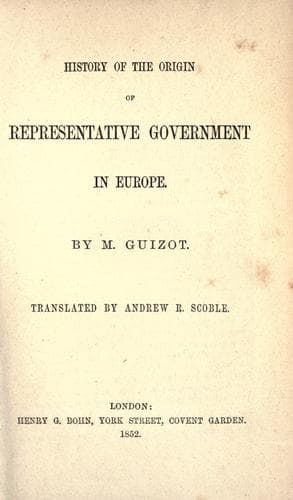
History of the Origin of Representative Government in EuropeGuizot, François
History
History of the Origin of Representative Government in Europe
Guizot, François
Europe -- History; Representative government and representation
shall be chosen by lot: the interpretation makes this rule
general, and requires five men to be chosen from the leading
members of the same rank as the accused person, that is,
decurions or plebeians, according to the condition of the accused
person himself. Finally, the text ordained that every judge
should receive his _domesticus_ or _cancellarius_ from
the choice of the principal persons employed in his chancery: the
interpretation retains the rule, merely substituting the
burgesses of the city for the persons employed in the chancery."
{244}
Objections To Savigny's Theory.
Such are the traces of municipal liberties which M. de Savigny
discovers in the _Breviarium Aniani_, and which he considers
as the common and permanent law of the Visigothic monarchy. They
prove, in fact, not merely the maintenance, but also the
extension and enfranchisement, of the rights and guarantees
possessed by the inhabitants of the towns before the settlement
of the Barbarians. But strong objections may be raised against
the importance which the author attaches to these texts, and the
extent of the conclusions which he deduces therefrom.
I. The _Breviarium Aniani_ does not contain the common and
permanent law of the Spanish monarchy of the Visigoths. It only
gives the special legislation of the Roman subjects of the
Visigothic kings, when the kings resided at Toulouse, and had as
yet only uncertain possessions in Spain; when the South of Gaul
constituted the bulk, and almost the whole, of the kingdom. There
is nothing to prove that all that is contained in the
_Breviarium Aniani_, towards the end of the fifth century,
for the benefit of the Romans of Southern Gaul, subsisted in
Spain until the eighth century, for the benefit of the Goths and
Romans, when merged into a single nation. The silence of the
_Forum judicum_, which is the true code of the Spanish
Visigoths, upon most of these arrangements, proves more against
their maintenance than is demonstrated in their favour by the
text of the _Breviarium_, which was drawn up in another
place, at an earlier period, and for a portion only of the
people.
Abolition Of The Breviarium Aniani.
Public-domain text, read in full here on John Shaqi.
Reviews
Reviews
No reviews yet
Be the first to share your thoughts on this work.
Elsewhere in the archive
Join the Discussion
Join the discussion
Sign in to leave a comment or review.
Sign InorCreate an account