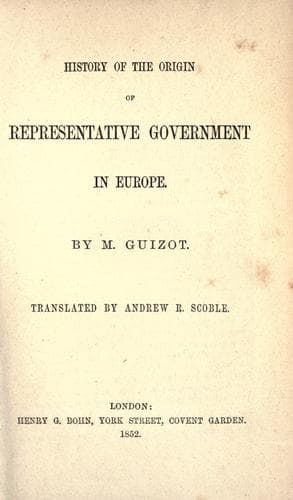
History of the Origin of Representative Government in EuropeGuizot, François
History
History of the Origin of Representative Government in Europe
Guizot, François
Europe -- History; Representative government and representation
It is more easy to explain, with likelihood, the existence of
these practices among the Spanish Goths of the twelfth century,
than to justify, without proofs, or rather in opposition to all
evidence, the arbitrary supposition of their prevalence among the
Visigoths of the seventh. Such institutions have in themselves
something of spontaneity; they correspond to a certain degree of
civilization, to a certain state of social institutions; we meet
with them under forms more or less similar, but fundamentally
analogous, not only among all the Germanic peoples, but also
among nearly all those barbaric peoples which, scarcely issued
from a nomadic life, begin to establish themselves on a new
territory, after they have conquered it. Now, the destruction of
the monarchy of the Visigoths by the Arabs suspended the course
of the institutions which it had received two centuries before,
broke off the councils of Toledo, crushed or greatly diminished
the predominance of the clergy, and, in fine, put a stop to the
civilization which had commenced, and gave to affairs an entirely
new direction.
{254}
Birth Of Free Institutions.
Scattered among the mountains, frequently wandering, separated
into various bands, those of the Goths who did not submit to the
conquerors, returned, so to speak, towards the life which their
ancestors led in the forests of Germany. Roman institutions,
Roman maxims, all that collection of laws and ideas which they
had received from the clergy, and which had prevailed over their
own habits, disappeared almost necessarily in this shock, or at
least were retained only by those Goths who remained under the
dominion of the Mussulmans. The companions of Pelagius, up to a
certain point, became Germans once more, from sheer necessity. It
was after this involuntary return to their primitive condition,
and, by consequence, to their ancient institutions, that they
resumed the offensive against the Arabs, and reconquered Spain by
degrees, bringing back with them those political and judicial
customs, usages, and practices, which they had partially
regained. Free institutions, moreover, could not fail to regain
vitality at this period; for they alone can supply strength in
times of danger or misfortune. It was not in the power of the
customs of the _officium palatinum_, and of the maxims of
the councils of Toledo, to restore the Goths to their subjugated
country, and reinstate the descendants of Chindasuinth upon the
throne of their fathers. The participation of the people in
public affairs, the sternness of Barbarian manners, and the
energy of irregular liberty, could alone produce such effects.
There is every reason to believe that the institutions of Spain,
after the re-establishment of the kingdoms of Castile, Leon,
Arragon, &c, were new institutions, and the result of the new
position of the Goths, much more than the legacy of the ancient
Visigoths. We find proofs of this in the general Cortes of the
Public-domain text, read in full here on John Shaqi.
Reviews
Reviews
No reviews yet
Be the first to share your thoughts on this work.
Elsewhere in the archive
Join the Discussion
Join the discussion
Sign in to leave a comment or review.
Sign InorCreate an account