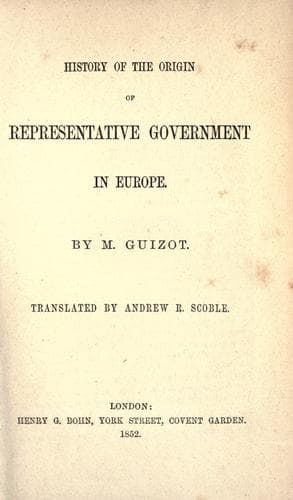
History of the Origin of Representative Government in EuropeGuizot, François
History
History of the Origin of Representative Government in Europe
Guizot, François
Europe -- History; Representative government and representation
I think it necessary to remind you, gentlemen, of the plan which
I adopted last year with regard to our study of the political
institutions of Europe. The essential object of that plan was to
give some unity and compactness to this vast history. And this is
not an arbitrary and self-chosen object. In the development of
our continent, all its peoples and all its governments are
connected together; in spite of all struggles and separations,
there is really some unity and compactness in European
civilization. This unity, which has been revealing itself from
day to day, is now evident; never have geographical limits
possessed less sway than in our times; never has such a community
of ideas, feelings, aspirations, and efforts united, in spite of
territorial demarcations, so great a mass of men. That which is
now revealed has been labouring for more than twelve centuries to
manifest itself; this external and apparent community has not
always existed; but such has always been, at bottom, the unity of
European civilization, that it is impossible thoroughly to
understand the history of any of the great modern peoples without
considering the history of Europe as a whole, and contemplating
the course pursued by humanity in general. It is a vast drama in
which every people has its part to perform, and with the general
events of which we must be acquainted in order to understand the
particular scenes connected therewith.
{258}
Epochs Of European History.
I have divided the history of the political institutions of
Europe into four great epochs, which are distinguished from each
other by essentially different characteristics. The first is the
barbarian epoch; a time of conflict and confusion, in which no
society could be established, no institution be founded and
become regularly prevalent in any part of Europe; this epoch
extends from the fifth to the tenth century. The second is the
feudal epoch, and extends from the tenth to the fourteenth
century. The third is the epoch of efforts towards constitutional
monarchy; feudalism declines, the populations become free, and
royalty employs them to extend and augment its power; this epoch
embraces the period from the fourteenth to the sixteenth century.
In the fourth period, on the Continent, all efforts towards a
representative system have failed or almost entirely disappeared;
pure monarchy prevails. England alone decidedly obtains a
constitutional government. This epoch lasts from the sixteenth
century to the French Revolution.
Public-domain text, read in full here on John Shaqi.
Reviews
Reviews
No reviews yet
Be the first to share your thoughts on this work.
Elsewhere in the archive
Join the Discussion
Join the discussion
Sign in to leave a comment or review.
Sign InorCreate an account