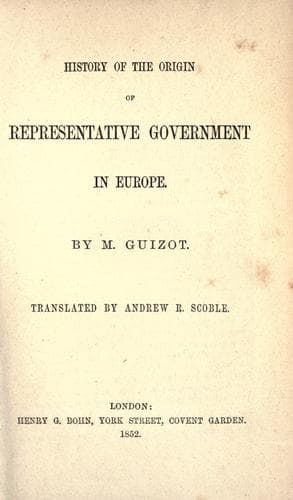
History of the Origin of Representative Government in EuropeGuizot, François
History
History of the Origin of Representative Government in Europe
Guizot, François
Europe -- History; Representative government and representation
Among local institutions, some were based upon common
deliberation, and others upon hierarchical subordination; that is
to say, some upon a principle of liberty, and others upon a
principle of dependence. On one side, were the courts of hundred
and the county-courts; on the other, the great landowners and
their vassals: every man of fourteen years old and upwards was
obliged to belong either to a hundred or to a lord, that is, to
be free or vassal.
{284}
These two hostile systems, then, placed in presence of one
another, conflicted as upon the Continent. There is some doubt
about the question whether, before the Conquest, feudalism
existed with regard to lands: that it existed with regard to
persons there can be no doubt, for their hierarchical
classification was real and progressive. In localities, although
the system of free institutions subsisted, the system of feudal
institutions was gaining ground; seignorial jurisdictions were
encroaching upon free jurisdictions; and almost the same process,
in fact, was going on as upon the Continent.
If we look at central institutions, we observe the same
phenomenon. On the Continent, feudalism was produced by the
aggrandizement of the king's vassals, and by the dislocation of
the sovereignty. The national unity, which resided in the
assembly of the nation, became dissolved; the monarchical unity
was unable to resist; and monarchy and liberty perished together.
Events had taken the same course among the Anglo-Saxons. Under
Edward the Confessor, the decay of the royal authority is
evident. Earl Godwin, Siward, Duke of Northumberland, Leofric,
Duke of Mercia, and many other great vassals, are rivals rather
than subjects of the king; and Harold usurping the crown from
Edgar Atheling, the legitimate heir, bears a strong resemblance
to Hugh Capet. The sovereignty tends to dismemberment.
Monarchical unity is in danger; national unity is in the same
declining state, as is proved by the history of the Wittenagemot.
This general assembly of the nation was at first the assembly of
the warriors; afterwards the general assembly of the land-owners,
both great and small; and at a later period, the assembly of the
great land-owners alone, or of the king's thanes. Even these at
last neglect to attend its meetings; and isolate themselves upon
their estates, in which each of them exercises his share of the
dismembered sovereignty. This is almost identical with the course
of affairs on the Continent. Only, the system of free
institutions still subsists in England with some energy in local
institutions, and especially in the county-courts. The feudal
system is in a less advanced state than on the Continent.
{285}
Norman Institutions.
Public-domain text, read in full here on John Shaqi.
Reviews
Reviews
No reviews yet
Be the first to share your thoughts on this work.
Elsewhere in the archive
Join the Discussion
Join the discussion
Sign in to leave a comment or review.
Sign InorCreate an account