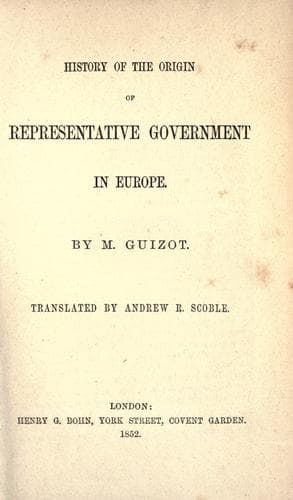
History of the Origin of Representative Government in EuropeGuizot, François
History
History of the Origin of Representative Government in Europe
Guizot, François
Europe -- History; Representative government and representation
The fact of this period which bears most importantly upon the
subject which we have under consideration, is the substitution of
the _escuage_ for the personal service of the vassals. It is
under the reign of Henry II. that we find this impost collected
for the first time, at least in the form of a general measure.
The establishment and limitations of the _escuage_ became
soon the principal object of contention between the king and his
barons. The use which the kings came to make of the resources
derived from this impost was fatal to them, for they employed it
in order to keep up armies of foreign mercenaries, especially
Brabanters; and by these measures, they gave a new motive to the
English barons to coalesce. The expulsion of foreign soldiers
became at length one of the continually recurring demands of the
barons.
Henry II. towards the close of his reign, imposed by his own
authority a tax of one sixth on all moveable property. He
abandoned the _danegeld_.
{307}
Reign Of Richard I.
The reign of Richard, which was entirely occupied with his
brilliant but unfortunate expeditions, offers nothing especially
illustrative of the history of institutions. The absence of the
king and the weakness of the royal power supplied the feudal
aristocracy with opportunities for extending their importance;
but they did not at that time take advantage of their superiority
to procure a recognition of their rights;--not until the reign of
John did the struggle become violent and the victory decisive.
{308}
Lecture VII.
Charter of John, or the Great Charter (1215).
Three epochs in John's reign.
Formation of a coalition among the barons.
Civil war.
Conference at Runnymead.
Concession of the Great Charter.
Analysis of this Charter.
Its stipulations refer to national rights as well as to those
of the barons.
John petitions and obtains from Innocent III. a bull to reverse
the Great Charter.
Resistance of the English clergy.
Recommencement of the civil war (October, 1215).
Louis of France, son of Philip Augustus, is appealed to by the
barons.
Death of John (October, 1216).
Reign Of King John.
Public-domain text, read in full here on John Shaqi.
Reviews
Reviews
No reviews yet
Be the first to share your thoughts on this work.
Elsewhere in the archive
Join the Discussion
Join the discussion
Sign in to leave a comment or review.
Sign InorCreate an account