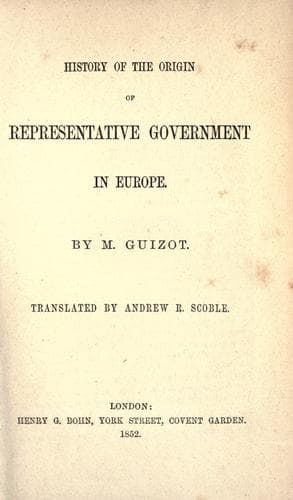
History of the Origin of Representative Government in EuropeGuizot, François
History
History of the Origin of Representative Government in Europe
Guizot, François
Europe -- History; Representative government and representation
Though such a right was granted, no guarantee was thereby given;
it only authorized civil war; it was to perpetuate the struggle
indefinitely, and formally to leave the ultimate decision of the
question to force. It was still far from being a regularly
constituted political guarantee; but the spirit of that age was
not capable either of discovering or of comprehending such a
guarantee--it could only understand the recognition of its
rights. However, the forcible guarantee which the Great Charter
established was so far valuable, inasmuch as it centralized the
feudal aristocracy by organizing the council of barons.
It has been often said that the Great Charter would not have been
supported by the barons had not it not been for its influence on
their special interests. This opinion is untenable: how is it
possible that at least a third of the articles should have
related to promises and guarantees made on behalf of the people,
if the aristocracy had only aimed at obtaining that which should
benefit themselves? We have only to read the Great Charter in
order to be convinced that the rights of all three orders of the
nation are equally respected and promoted.
Another question has been raised, as to whether John did or did
not grant a special charter relating to forests at the time when
he granted the Great Charter. Mathew Paris is the only author who
speaks of this charter of forests, and there are several reasons
why his authority should in this matter be rejected. First of
all, the preliminary articles of the Great Charter contain
nothing on this point; in the second place, Articles 44, 47, and
48 in the Great Charter itself settle whatever relates to
forests; and lastly, the king and the Pope, in their
correspondence prior to these events, make no allusion to this
twofold concession.
When the king had distinctly adopted each article of the Great
Charter, the agreement between him and his barons, which had been
concluded on the 15th of June, was executed in order to ensure
the fulfilment of his engagements. The guarding of the city of
London was entrusted to the barons till the 15th of August
following, and that of the Tower to the Archbishop of Canterbury.
{317}
Violation Of Magna Charta.
John dissembled at first, and appeared to submit without any
reserve to all the sacrifices which were imposed upon him; but
such a mask soon became intolerable to him. After a short time he
broke out into complaints and threatenings, and retired in fury
to the Isle of Wight. While there, he procured the enrolment of
an army of Brabanters in order to regain his power by battle, and
despatched a messenger to Rome beseeching for aid against the
violence that had been done him. Innocent III., hearing what had
occurred, and irritated by the audacity of the barons, whom he
called his vassals, annulled the Great Charter, and
excommunicated all the barons who had joined in the rebellion.
Public-domain text, read in full here on John Shaqi.
Reviews
Reviews
No reviews yet
Be the first to share your thoughts on this work.
Elsewhere in the archive
Join the Discussion
Join the discussion
Sign in to leave a comment or review.
Sign InorCreate an account