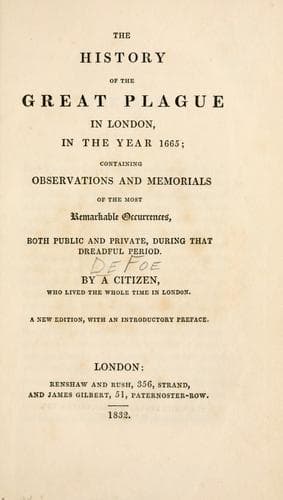
Historical fiction; London (England) -- History -- 17th century -- Fiction; Plague -- Fiction
I give this story thus at large, principally to give an account[219]
what became of the great numbers of people which immediately appeared in
the city as soon as the sickness abated; for, as I have said, great
numbers of those that were able, and had retreats in the country, fled
to those retreats. So when it[220] was increased to such a frightful
extremity as I have related, the middling people[221] who had not
friends fled to all parts of the country where they could get shelter,
as well those that had money to relieve themselves as those that had
not. Those that had money always fled farthest, because they were able
to subsist themselves; but those who were empty suffered, as I have
said, great hardships, and were often driven by necessity to relieve
their wants at the expense of the country. By that means the country was
made very uneasy at them, and sometimes took them up, though even then
they scarce knew what to do with them, and were always very backward to
punish them; but often, too, they forced them from place to place, till
they were obliged to come back again to London.
I have, since my knowing this story of John and his brother, inquired,
and found that there were a great many of the poor disconsolate people,
as above, fled into the country every way; and some of them got little
sheds and barns and outhouses to live in, where they could obtain so
much kindness of the country, and especially where they had any, the
least satisfactory account to give of themselves, and particularly that
they did not come out of London too late. But others, and that in great
numbers, built themselves little huts and retreats in the fields and
woods, and lived like hermits in holes and caves, or any place they
could find, and where, we may be sure, they suffered great extremities,
such that many of them were obliged to come back again, whatever the
danger was. And so those little huts were often found empty, and the
country people supposed the inhabitants lay dead in them of the plague,
and would not go near them for fear, no, not in a great while; nor is it
unlikely but that some of the unhappy wanderers might die so all alone,
even sometimes for want of help, as particularly in one tent or hut was
found a man dead, and on the gate of a field just by was cut with his
knife, in uneven letters, the following words, by which it may be
supposed the other man escaped, or that, one dying first, the other
buried him as well as he could:--
O m I s E r Y!
We Bo T H Sh a L L D y E,
W o E, W o E
Public-domain text, read in full here on John Shaqi.
Reviews
Reviews
No reviews yet
Be the first to share your thoughts on this work.
Elsewhere in the archive
Join the Discussion
Join the discussion
Sign in to leave a comment or review.
Sign InorCreate an account