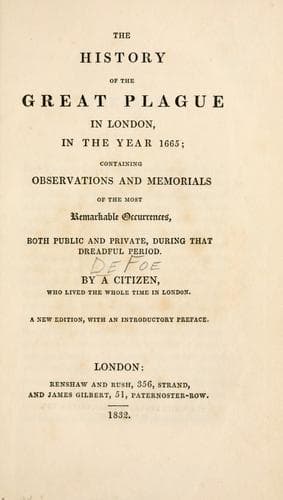
Historical fiction; London (England) -- History -- 17th century -- Fiction; Plague -- Fiction
As it brought the people into public company, so it was surprising how
it brought them to crowd into the churches. They inquired no more into
who[246] they sat near to or far from, what offensive smells they met
with, or what condition the people seemed to be in; but, looking upon
themselves all as so many dead corpses, they came to the churches
without the least caution, and crowded together as if their lives were
of no consequence compared to the work which they came about there.
Indeed, the zeal which they showed in coming, and the earnestness and
affection they showed in their attention to what they heard, made it
manifest what a value people would all put upon the worship of God if
they thought every day they attended at the church that it would be
their last. Nor was it without other strange effects, for it took away
all manner of prejudice at, or scruple about, the person whom they found
in the pulpit when they came to the churches. It cannot be doubted but
that many of the ministers of the parish churches were cut off among
others in so common and dreadful a calamity; and others had not courage
enough to stand it, but removed into the country as they found means for
escape. As then some parish churches were quite vacant and forsaken, the
people made no scruple of desiring such dissenters as had been a few
years before deprived of their livings, by virtue of an act of
Parliament called the "Act of Uniformity,"[247] to preach in the
churches, nor did the church ministers in that case make any difficulty
in accepting their assistance; so that many of those whom they called
silent ministers had their mouths opened on this occasion, and preached
publicly to the people.
Here we may observe, and I hope it will not be amiss to take notice of
it, that a near view of death would soon reconcile men of good
principles one to another, and that it is chiefly owing to our easy
situation in life, and our putting these things far from us, that our
breaches are fomented, ill blood continued, prejudices, breach of
charity and of Christian union so much kept and so far carried on among
us as it is. Another plague year would reconcile all these differences;
a close conversing with death, or with diseases that threaten death,
would scum off the gall from our tempers, remove the animosities among
us, and bring us to see with differing eyes than those which we looked
on things with before. As the people who had been used to join with the
church were reconciled at this time with the admitting the dissenters to
preach to them, so the dissenters, who, with an uncommon prejudice, had
broken off from the communion of the Church of England, were now content
to come to their parish churches, and to conform to the worship which
they did not approve of before. But, as the terror of the infection
abated, those things all returned again to their less desirable
channel, and to the course they were in before.
Public-domain text, read in full here on John Shaqi.
Reviews
Reviews
No reviews yet
Be the first to share your thoughts on this work.
Elsewhere in the archive
Join the Discussion
Join the discussion
Sign in to leave a comment or review.
Sign InorCreate an account