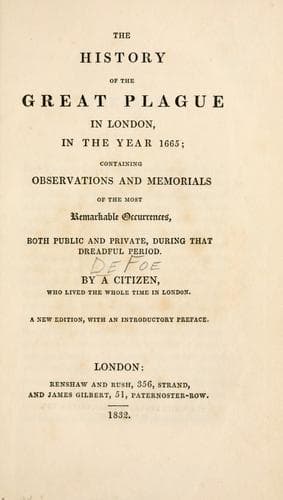
Historical fiction; London (England) -- History -- 17th century -- Fiction; Plague -- Fiction
I must acknowledge that this time was so terrible that I was sometimes
at the end of all my resolutions, and that I had not the courage that I
had at the beginning. As the extremity brought other people abroad, it
drove me home; and, except having made my voyage down to Blackwall and
Greenwich, as I have related, which was an excursion, I kept afterwards
very much within doors, as I had for about a fortnight before. I have
said already that I repented several times that I had ventured to stay
in town, and had not gone away with my brother and his family; but it
was too late for that now. And after I had retreated and staid within
doors a good while before my impatience led me abroad, then they called
me, as I have said, to an ugly and dangerous office, which brought me
out again; but as that was expired, while the height of the distemper
lasted I retired again, and continued close ten or twelve days more,
during which many dismal spectacles represented themselves in my
view,[249] out of my own windows, and in our own street, as that
particularly, from Harrow Alley, of the poor outrageous creature who
danced and sung in his agony; and many others there were. Scarce a day
or a night passed over but some dismal thing or other happened at the
end of that Harrow Alley, which was a place full of poor people, most of
them belonging to the butchers, or to employments depending upon the
butchery.
Sometimes heaps and throngs of people would burst out of the alley, most
of them women, making a dreadful clamor, mixed or compounded of
screeches, cryings, and calling one another, that we could not conceive
what to make of it. Almost all the dead part of the night,[250] the dead
cart stood at the end of that alley; for if it went in, it could not
well turn again, and could go in but a little way. There, I say, it
stood to receive dead bodies; and, as the churchyard was but a little
way off, if it went away full, it would soon be back again. It is
impossible to describe the most horrible cries and noise the poor people
would make at their bringing the dead bodies of their children and
friends out to the cart; and, by the number, one would have thought
there had been none left behind, or that there were people enough for a
small city living in those places. Several times they cried murder,
sometimes fire; but it was easy to perceive that it was all distraction
and the complaints of distressed and distempered people.
I believe it was everywhere thus at that time, for the plague raged for
six or seven weeks beyond all that I have expressed, and came even to
such a height, that, in the extremity, they began to break into that
excellent order of which I have spoken so much in behalf of the
magistrates, namely, that no dead bodies were seen in the streets, or
burials in the daytime; for there was a necessity in this extremity to
bear with its being otherwise for a little while.
Public-domain text, read in full here on John Shaqi.
Reviews
Reviews
No reviews yet
Be the first to share your thoughts on this work.
Elsewhere in the archive
Join the Discussion
Join the discussion
Sign in to leave a comment or review.
Sign InorCreate an account