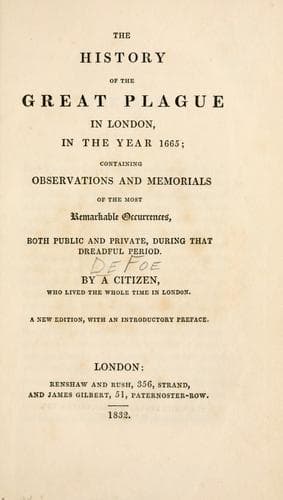
Historical fiction; London (England) -- History -- 17th century -- Fiction; Plague -- Fiction
In like manner the sheriffs and aldermen did,[257] in their several
stations and wards, where they were placed by office; and the sheriff's
officers or sergeants were appointed to receive orders from the
respective aldermen in their turn; so that justice was executed in all
cases without interruption. In the next place, it was one of their
particular cares to see the orders for the freedom of the markets
observed; and in this part either the lord mayor, or one or both of the
sheriffs, were every market day on horseback to see their orders
executed, and to see that the country people had all possible
encouragement and freedom in their coming to the markets and going back
again, and that no nuisance or frightful object should be seen in the
streets to terrify them, or make them unwilling to come. Also the bakers
were taken under particular order, and the master of the Bakers' Company
was, with his court of assistants, directed to see the order of my lord
mayor for their regulation put in execution, and the due assize[258] of
bread, which was weekly appointed by my lord mayor, observed; and all
the bakers were obliged to keep their ovens going constantly, on pain of
losing the privileges of a freeman of the city of London.
By this means, bread was always to be had in plenty, and as cheap as
usual, as I said above; and provisions were never wanting in the
markets, even to such a degree that I often wondered at it, and
reproached myself with being so timorous and cautious in stirring
abroad, when the country people came freely and boldly to market, as if
there had been no manner of infection in the city, or danger of catching
it.
It was indeed one admirable piece of conduct in the said magistrates,
that the streets were kept constantly clear and free from all manner of
frightful objects, dead bodies, or any such things as were indecent or
unpleasant; unless where anybody fell down suddenly, or died in the
streets, as I have said above, and these were generally covered with
some cloth or blanket, or removed into the next churchyard till night.
All the needful works that carried terror with them, that were both
dismal and dangerous, were done in the night. If any diseased bodies
were removed, or dead bodies buried, or infected clothes burned, it was
done in the night; and all the bodies which were thrown into the great
pits in the several churchyards or burying grounds, as has been
observed, were so removed in the night, and everything was covered and
closed before day. So that in the daytime there was not the least signal
of the calamity to be seen or heard of, except what was to be observed
from the emptiness of the streets, and sometimes from the passionate
outcries and lamentations of the people, out at their windows, and from
the numbers of houses and shops shut up.
Public-domain text, read in full here on John Shaqi.
Reviews
Reviews
No reviews yet
Be the first to share your thoughts on this work.
Elsewhere in the archive
Join the Discussion
Join the discussion
Sign in to leave a comment or review.
Sign InorCreate an account