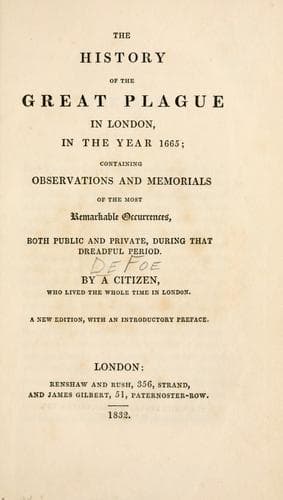
Historical fiction; London (England) -- History -- 17th century -- Fiction; Plague -- Fiction
And here let me take leave to enter again, though it may seem a
repetition of circumstances, into a description of the miserable
condition of the city itself, and of those parts where I lived, at this
particular time. The city, and those other parts, notwithstanding the
great numbers of people that were gone into the country, was[261] vastly
full of people; and perhaps the fuller because people had for a long
time a strong belief that the plague would not come into the city, nor
into Southwark, no, nor into Wapping or Ratcliff at all; nay, such was
the assurance of the people on that head, that many removed from the
suburbs on the west and north sides into those eastern and south sides
as for safety, and, as I verily believe, carried the plague amongst them
there, perhaps sooner than they would otherwise have had it.
Here, also, I ought to leave a further remark for the use of posterity,
concerning the manner of people's infecting one another; namely, that it
was not the sick people only from whom the plague was immediately
received by others that were sound, but the well. To explain myself: by
the sick people, I mean those who were known to be sick, had taken
their beds, had been under cure, or had swellings or tumors upon them,
and the like. These everybody could beware of: they were either in their
beds, or in such condition as could not be concealed.
By the well, I mean such as had received the contagion, and had it
really upon them and in their blood, yet did not show the consequences
of it in their countenances; nay, even were not sensible of it
themselves, as many were not for several days. These breathed death in
every place, and upon everybody who came near them; nay, their very
clothes retained the infection; their hands would infect the things they
touched, especially if they were warm and sweaty, and they were
generally apt to sweat, too.
Now, it was impossible to know these people, nor did they sometimes, as
I have said, know themselves, to be infected. These were the people that
so often dropped down and fainted in the streets; for oftentimes they
would go about the streets to the last, till on a sudden they would
sweat, grow faint, sit down at a door, and die. It is true, finding
themselves thus, they would struggle hard to get home to their own
doors, or at other times would be just able to go into their houses, and
die instantly. Other times they would go about till they had the very
tokens come out upon them, and yet not know it, and would die in an hour
or two after they came home, but be well as long as they were abroad.
These were the dangerous people; these were the people of whom the well
people ought to have been afraid: but then, on the other side, it was
impossible to know them.
Public-domain text, read in full here on John Shaqi.
Reviews
Reviews
No reviews yet
Be the first to share your thoughts on this work.
Elsewhere in the archive
Join the Discussion
Join the discussion
Sign in to leave a comment or review.
Sign InorCreate an account