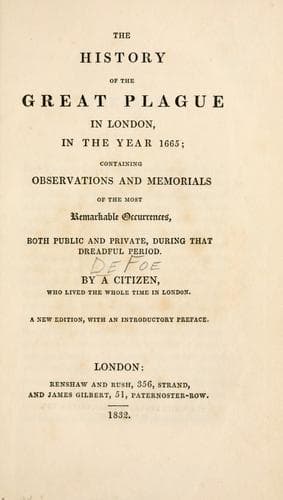
Historical fiction; London (England) -- History -- 17th century -- Fiction; Plague -- Fiction
The manner of its first coming to London proves this also, viz., by
goods brought over from Holland, and brought thither from the Levant;
the first breaking of it out in a house in Longacre where those goods
were carried and first opened; its spreading from that house to other
houses by the visible unwary conversing with those who were sick, and
the infecting the parish officers who were employed about persons dead;
and the like. These are known authorities for this great foundation
point, that it went on and proceeded from person to person, and from
house to house, and no otherwise. In the first house that was infected,
there died four persons. A neighbor, hearing the mistress of the first
house was sick, went to visit her, and went home and gave the distemper
to her family, and died, and all her household. A minister called to
pray with the first sick person in the second house was said to sicken
immediately, and die, with several more in his house. Then the
physicians began to consider, for they did not at first dream of a
general contagion; but the physicians being sent to inspect the bodies,
they assured the people that it was neither more or less than the
plague, with all its terrifying particulars, and that it threatened an
universal infection; so many people having already conversed with the
sick or distempered, and having, as might be supposed, received
infection from them, that it would be impossible to put a stop to it.
Here the opinion of the physicians agreed with my observation
afterwards, namely, that the danger was spreading insensibly: for the
sick could infect none but those that came within reach of the sick
person; but that one man, who may have really received the infection,
and knows it not, but goes abroad and about as a sound person, may give
the plague to a thousand people, and they to greater numbers in
proportion, and neither the person giving the infection, nor the persons
receiving it, know anything of it, and perhaps not feel the effects of
it for several days after. For example:--
Many persons, in the time of this visitation, never perceived that they
were infected till they found, to their unspeakable surprise, the tokens
come out upon them, after which they seldom lived six hours; for those
spots they called the tokens were really gangrene spots, or mortified
flesh, in small knobs as broad as a little silver penny, and hard as a
piece of callus[264] or horn; so that when the disease was come up to
that length, there was nothing could follow but certain death. And yet,
as I said, they knew nothing of their being infected, nor found
themselves so much as out of order, till those mortal marks were upon
them. But everybody must allow that they were infected in a high degree
before, and must have been so some time; and consequently their breath,
their sweat, their very clothes, were contagious for many days before.
Public-domain text, read in full here on John Shaqi.
Reviews
Reviews
No reviews yet
Be the first to share your thoughts on this work.
Elsewhere in the archive
Join the Discussion
Join the discussion
Sign in to leave a comment or review.
Sign InorCreate an account