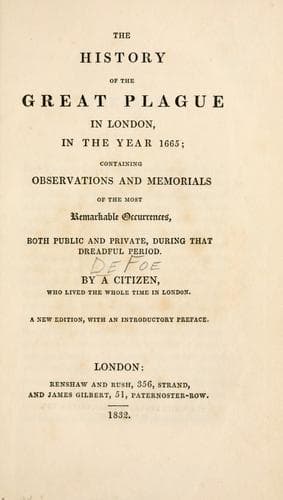
Historical fiction; London (England) -- History -- 17th century -- Fiction; Plague -- Fiction
It may be proper to ask here how long it may be supposed men might have
the seeds of the contagion in them before it discovered[265] itself in
this fatal manner, and how long they might go about seemingly whole, and
yet be contagious to all those that came near them. I believe the most
experienced physicians cannot answer this question directly any more
than I can; and something an ordinary observer may take notice of which
may pass their observation. The opinion of physicians abroad seems to
be, that it may lie dormant in the spirits, or in the blood vessels, a
very considerable time: why else do they exact a quarantine of those who
come into their harbors and ports from suspected places? Forty days is,
one would think, too long for nature to struggle with such an enemy as
this, and not conquer it or yield to it; but I could not think by my own
observation that they can be infected, so as to be contagious to others,
above fifteen or sixteen days at farthest; and on that score it was,
that when a house was shut up in the city, and any one had died of the
plague, but nobody appeared to be ill in the family for sixteen or
eighteen days after, they were not so strict but that they[266] would
connive at their going privately abroad; nor would people be much afraid
of them afterwards, but rather think they were fortified the better,
having not been vulnerable when the enemy was in their house: but we
sometimes found it had lain much longer concealed.
Upon the foot of all these observations I must say, that, though
Providence seemed to direct my conduct to be otherwise, it is my
opinion, and I must leave it as a prescription, viz., that the best
physic against the plague is to run away from it. I know people
encourage themselves by saying, "God is able to keep us in the midst of
danger, and able to overtake us when we think ourselves out of danger;"
and this kept thousands in the town whose carcasses went into the great
pits by cartloads, and who, if they had fled from the danger, had, I
believe, been safe from the disaster: at least, 'tis probable they had
been safe.
And were this very fundamental[267] only duly considered by the people
on any future occasion of this or the like nature, I am persuaded it
would put them upon quite different measures for managing the people
from those that they took in 1665, or than any that have been taken
abroad that I have heard of: in a word, they would consider of
separating the people into smaller bodies, and removing them in time
farther from one another, and not let such a contagion as this, which is
indeed chiefly dangerous to collected bodies of people, find a million
of people in a body together, as was very near the case before, and
would certainly be the case if it should ever appear again.
Public-domain text, read in full here on John Shaqi.
Reviews
Reviews
No reviews yet
Be the first to share your thoughts on this work.
Elsewhere in the archive
Join the Discussion
Join the discussion
Sign in to leave a comment or review.
Sign InorCreate an account