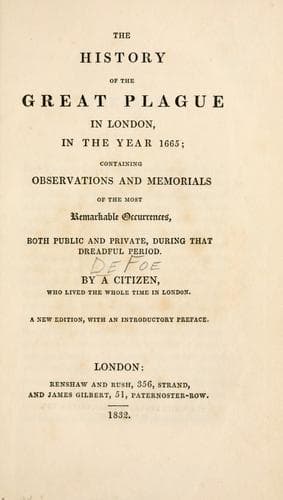
Historical fiction; London (England) -- History -- 17th century -- Fiction; Plague -- Fiction
It is true that the next year made them full amends by another terrible
calamity upon the city; so that the city by one calamity impoverished
and weakened the country, and by another calamity (even terrible, too,
of its kind) enriched the country, and made them again amends: for an
infinite quantity of household stuff, wearing apparel, and other
things, besides whole warehouses filled with merchandise and
manufactures, such as come from all parts of England, were consumed in
the fire of London the next year after this terrible visitation. It is
incredible what a trade this made all over the whole kingdom, to make
good the want, and to supply that loss; so that, in short, all the
manufacturing hands in the nation were set on work, and were little
enough for several years to supply the market, and answer the demands.
All foreign markets also were empty of our goods, by the stop which had
been occasioned by the plague, and before an open trade was allowed
again; and the prodigious demand at home falling in, joined to make a
quick vent[306] for all sorts of goods; so that there never was known
such a trade all over England, for the time, as was in the first seven
years after the plague, and after the fire of London.
It remains now that I should say something of the merciful part of this
terrible judgment. The last week in September, the plague being come to
its crisis, its fury began to assuage. I remember my friend Dr. Heath,
coming to see me the week before, told me he was sure the violence of it
would assuage in a few days; but when I saw the weekly bill of that
week, which was the highest of the whole year, being 8,297 of all
diseases, I upbraided him with it, and asked him what he had made his
judgment from. His answer, however, was not so much to seek[307] as I
thought it would have been. "Look you," says he: "by the number which
are at this time sick and infected, there should have been twenty
thousand dead the last week, instead of eight thousand, if the
inveterate mortal contagion had been as it was two weeks ago; for then
it ordinarily killed in two or three days, now not under eight or ten;
and then not above one in five recovered, whereas I have observed that
now not above two in five miscarry. And observe it from me, the next
bill will decrease, and you will see many more people recover than used
to do; for though a vast multitude are now everywhere infected, and as
many every day fall sick, yet there will not so many die as there did,
for the malignity of the distemper is abated;" adding that he began now
to hope, nay, more than hope, that the infection had passed its crisis,
and was going off. And accordingly so it was; for the next week being,
as I said, the last in September, the bill decreased almost two
thousand.
Public-domain text, read in full here on John Shaqi.
Reviews
Reviews
No reviews yet
Be the first to share your thoughts on this work.
Elsewhere in the archive
Join the Discussion
Join the discussion
Sign in to leave a comment or review.
Sign InorCreate an account