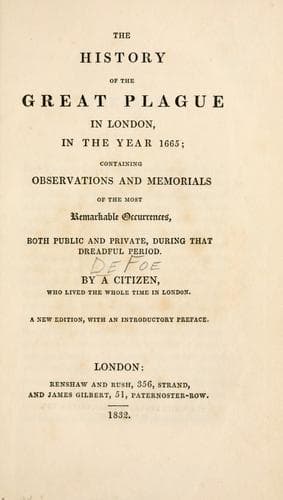
Historical fiction; London (England) -- History -- 17th century -- Fiction; Plague -- Fiction
From the river they traveled towards the forest; but when they came to
Walthamstow, the people of that town denied[197] to admit them, as was
the case everywhere; the constables and their watchmen kept them off at
a distance, and parleyed with them. They gave the same account of
themselves as before; but these gave no credit to what they said, giving
it for a reason, that two or three companies had already come that way
and made the like pretenses, but that they had given several people the
distemper in the towns where they had passed, and had been afterwards so
hardly used by the country, though with justice too, as they had
deserved, that about Brentwood[198] or that way, several of them
perished in the fields, whether of the plague, or of mere want and
distress, they could not tell.
This was a good reason, indeed, why the people of Walthamstow should be
very cautious, and why they should resolve not to entertain anybody that
they were not well satisfied of; but as Richard the joiner, and one of
the other men who parleyed with them, told them, it was no reason why
they should block up the roads and refuse to let the people pass through
the town, and who asked nothing of them but to go through the street;
that, if their people were afraid of them, they might go into their
houses and shut their doors: they would neither show them civility nor
incivility, but go on about their business.
The constables and attendants, not to be persuaded by reason, continued
obstinate, and would hearken to nothing: so the two men that talked with
them went back to their fellows to consult what was to be done. It was
very discouraging in the whole, and they knew not what to do for a good
while; but at last John, the soldier and biscuit baker, considering
awhile, "Come," says he, "leave the rest of the parley to me." He had
not appeared yet: so he sets the joiner, Richard, to work to cut some
poles out of the trees, and shape them as like guns as he could; and in
a little time he had five or six fair muskets, which at a distance would
not be known; and about the part where the lock of a gun is, he caused
them to wrap cloth and rags, such as they had, as soldiers do in wet
weather to preserve the locks of their pieces from rust; the rest was
discolored with clay or mud, such as they could get; and all this while
the rest of them sat under the trees by his direction, in two or three
bodies, where they made fires at a good distance from one another.
Public-domain text, read in full here on John Shaqi.
Reviews
Reviews
No reviews yet
Be the first to share your thoughts on this work.
Elsewhere in the archive
Join the Discussion
Join the discussion
Sign in to leave a comment or review.
Sign InorCreate an account