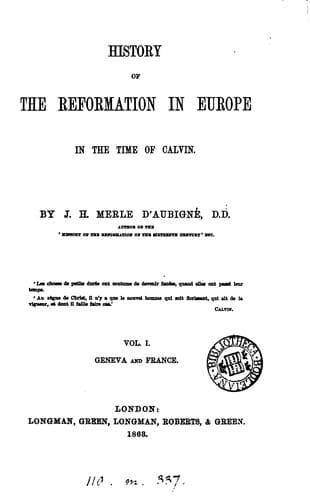
History of the Reformation in Europe in the Time of Calvin, Vol. 6 (of 8)Merle d'Aubigné, J. H. (Jean Henri)
History
History of the Reformation in Europe in the Time of Calvin, Vol. 6 (of 8)
Merle d'Aubigné, J. H. (Jean Henri)
Reformation
James had yet other causes of uneasiness. His sleepless nights were
disturbed, gloomy, and agitated; and even the light of morning did not
disperse his inward darkness. The death of Hamilton, whose execution
he had hastily ordered on mere suspicion, frequently gave him bitter
pain. That unfortunate lord had done for the prince all that he had
wished; and the latter now asked himself whether he had done well to
deprive himself of so devoted a secretary. Perhaps he was innocent.
He might have been calumniated. One night, at Linlithgow, James saw
Hamilton in a dream, with his sword drawn, rush upon him and cut off
first his right then his left arm,[239] saying to him, ‘Take that!
while thou receive a final payment for all thine impiety.’ James
awoke trembling, and asked himself what this dream could mean. His
imagination was impressed by it. He mused mournfully on the strange
vision, and expected that some heavy blow was about to fall on him. It
was in this state of mind that a message reached him from Stirling that
his son Arthur has just died. Shortly after, another message came from
St. Andrews to announce to him that his son James was dead. These two
young princes, his hope, his joy, and his glory, were no more. Within
twenty-four hours of each other (some say at the same hour), they had
been taken from him. He now comprehended his dream. His two arms were
already cut off: it only remained for him to lose his own life, and all
would be accomplished. Nothing could divert this prince, who was guilty
at once of profligacy and of persecution: nothing could beguile his
grief. His heart was broken, his mind was disordered.
He shut himself up, and the only person whom he would see was his
mother. Unhappy father! unhappy king! The queen-dowager did all she
could to console her son and her daughter-in-law. ‘I am never from
them,’ she wrote to her brother, Henry VIII., May 12, 1541, ‘but ever
in their company.’ It appears that by this large sorrow the natural
affections were reawakened in the king. He wrote to his uncle that he
desired to see good will and the most perfect friendship and peace
prevail between them.[240]
[Sidenote: PROGRESS OF THE REFORMATION.]
While James was thus taken up with his sorrows alone, the doctrine of
the Reformation made progress, and, if only liberty were accorded to
it, its triumph in Scotland appeared to be at hand. A great multitude
of the common people, both in the country districts and in the towns,
held meetings more or less secretly at which they heard the Holy Word
read and even explained. By 1540 many eminent men had received the
evangelical doctrine. The earls of Errol and of Glencairn, the Lords
Ruthven and Kilmaurs and their children, Sir David Lyndsay, Sir James
Sandilands, Melville of Raith, and a large number of other influential
persons appeared to be attached to the Gospel by genuine conviction.
Public-domain text, read in full here on John Shaqi.
Reviews
Reviews
No reviews yet
Be the first to share your thoughts on this work.
Elsewhere in the archive
Join the Discussion
Join the discussion
Sign in to leave a comment or review.
Sign InorCreate an account