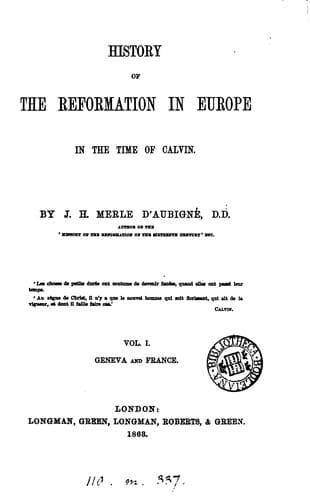
History of the Reformation in Europe in the Time of Calvin, Vol. 6 (of 8)Merle d'Aubigné, J. H. (Jean Henri)
History
History of the Reformation in Europe in the Time of Calvin, Vol. 6 (of 8)
Merle d'Aubigné, J. H. (Jean Henri)
Reformation
While these wholesome measures were being adopted, the alliance of the
country with England appeared to be growing stronger; and even if a
purely evangelical reformation was not to be looked for, the ties which
bound Scotland to Rome must certainly be broken. On Sunday afternoon,
March 18, the day after the closing of the session of parliament,
arrived Sir Ralph Sadler, an envoy from Henry VIII. He betook himself
that very evening to Holyrood, and there learnt from the regent the
resolutions which had just been taken. Sadler was charged with the duty
of concluding the marriage contract between Edward and Mary, as well as
the project of a perpetual alliance between the two countries.[287]
Sadler, who acted in the business with his utmost energy, soon found
that the Scots were not prepared to go to the same length as his
master. ‘In my opinion,’ he wrote (March 27), ‘they had lever suffer
extremity than come to the obedience and subjection of England: they
will have their realm free and live within themselves after their own
laws and customs.... I think assuredly all the nobles and the whole
temporality of this realm desire the marriage and to join with us
in perfect friendship: in which case I think also they will utterly
abandon France.’ This was not what Henry was aiming at. After the death
of the young princess, the Tudors, in his view, were to inherit her
kingdom.
The alliance, nevertheless, was concluded. On July 1 the earl of
Glencairn, Sir George Douglas, Learmont, and Balnaves, the Scottish
envoys, signed at Greenwich the treaty of marriage and of peace. This
treaty was solemnly read, August 25, in Holyrood abbey, and was there
signed, sealed, and approved by the regent and the nobles. The queen
was to remain in Scotland until she should be ten years old, and then
be taken into England to be educated. Three Scottish lords should be
given as hostages to Henry; and in confirmation of the alliance a
consecrated wafer, according to a Romish usage, was broken between
the regent and Sir R. Sadler, the representative of Henry VIII. Each
of them received and ate half of it, in token of their unity and as a
pledge of their fidelity,--a strange method of cementing an alliance
which had for its end the destruction of Romish superstitions. The
treaty was published everywhere as a basis of perpetual agreement; but
the union of the two nations had still many a storm to encounter.
CHAPTER XIII.
BEATOUN IS LIBERATED AND RECOVERS HIS POWER.--BREACH OF THE
TREATY.--FRESH PERSECUTION.
(MARCH, 1543.-SUMMER OF 1544.)
Public-domain text, read in full here on John Shaqi.
Reviews
Reviews
No reviews yet
Be the first to share your thoughts on this work.
Elsewhere in the archive
Join the Discussion
Join the discussion
Sign in to leave a comment or review.
Sign InorCreate an account