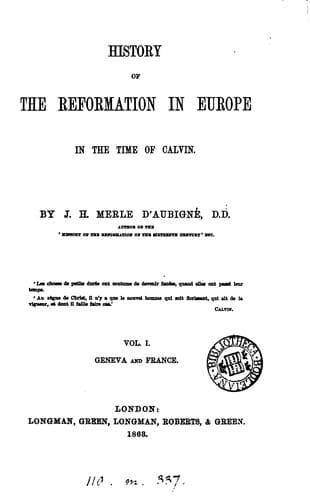
History of the Reformation in Europe in the Time of Calvin, Vol. 6 (of 8)Merle d'Aubigné, J. H. (Jean Henri)
History
History of the Reformation in Europe in the Time of Calvin, Vol. 6 (of 8)
Merle d'Aubigné, J. H. (Jean Henri)
Reformation
Wishart persevered in his work, and his reputation spread all around.
The men of Mauchlin came and asked him to preach the Gospel to them
on the following Sunday. But the sheriff of Ayr heard of it, and sent
a body of men in the night to post themselves about the church. ‘We
will enter by force,’ said Hugh Campbell to Wishart. ‘Brother,’ replied
the evangelist, ‘it is the word of peace which God sends by me; the
blood of no man shall be shed this day for the preaching of it. I find
that Christ Jesus oftener preached in the desert, at the seaside, and
other places judged profane, than he did in the temple of Jerusalem.’
He then withdrew to the country, saying to the people who followed him
that the Saviour was ‘as potent upon the fields as in the kirk.’ He
climbed up a dike raised on the edge of the moorland, and there, in the
fair warm day, preached for more than three hours. One man present,
Lawrence Ranken, laird of Shield, who had previously led a wicked life,
was impressed by what he heard. ‘The tears ran from his eyes in such
abundance that all men wondered.’[331] Converted by that discourse,
the laird of Shield gave evidence in his whole after-life that his
conversion was genuine. Wishart preached with like success in the whole
district. The harvest was great, says one historian.
The reformer heard on a sudden that the plague had broken out at Dundee
four days after he left the town, and that it was raging cruelly. He
resolved instantly to go there. ‘They are now in trouble and they need
comfort,’ he said to those who would fain hold him back: ‘perchance
this hand of God will make them now to magnify and reverence that word
which before, for the fear of men, they set at light part.’
He reached Dundee in August, 1544, and announced the same morning that
he would preach. It was necessary to keep apart the plague-stricken
from those who were in health, and for that purpose he took his station
at the east gate of the town. Those who were in health had their
place within the city, and those who were sick remained without. Such
a distribution of an audience was surely never seen before! Wishart
opened the Bible and read these words--‘He sent his word and healed
them.’ (Ps. cvii. 20.) ‘The mercy of God,’ said he, ‘is prompt to fall
on all such as truly turn to Him, and the malice of men can neither eik
nor pair [add to nor diminish] his gentle visitation.’[332]--‘We do not
fear death,’ said some of his hearers; ‘nay, we judge them more happy
that should depart, than such as should remain behind.’ That east gate
of Dundee (Cowgate) was left standing in memory of Wishart when the
town walls were taken down at the close of the eighteenth century, and
it is still carefully preserved.
Wishart was not satisfied with speech alone, he personally visited the
sick, fearlessly exposing himself to infection in the most extreme
cases. He took care that the sick should have what they needed, and the
poor were as well provided for as the rich.
Public-domain text, read in full here on John Shaqi.
Reviews
Reviews
No reviews yet
Be the first to share your thoughts on this work.
Elsewhere in the archive
Join the Discussion
Join the discussion
Sign in to leave a comment or review.
Sign InorCreate an account