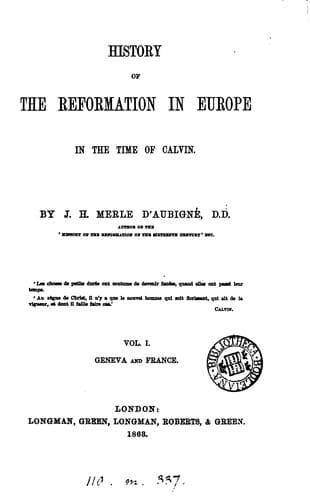
History of the Reformation in Europe in the Time of Calvin, Vol. 6 (of 8)Merle d'Aubigné, J. H. (Jean Henri)
History
History of the Reformation in Europe in the Time of Calvin, Vol. 6 (of 8)
Merle d'Aubigné, J. H. (Jean Henri)
Reformation
The next day the dean of St. Andrews went to the prison where Wishart
was confined, and summoned him in the cardinal’s name to appear before
the judges on the morrow. ‘What needed,’ replied the prisoner, ‘my
lord cardinal to summon me to answer for my doctrine openly before
him, under whose power and dominion I am thus straitly bound in irons?
May not my lord compel me to answer to his extorted power?’ On March
1 the cardinal ordered all the household servants of his palace to
put themselves under arms. The civil power, it is remembered, had
refused to take part in the proceedings, and therefore Beatoun took
its place. His men at once equipped themselves with lances, swords,
axes, knapsacks, and other warlike array. It might have been thought
that some military action was in hand, rather than a gathering of
priests who assumed to busy themselves about God’s Church. These armed
champions, putting themselves in marching order, first escorted the
bishops with great ceremony to the abbey church, and then went for
Wishart. The governor of the castle put himself at the head of the
band, and so they led the prisoner ‘like a lamb to sacrifice.’ As he
entered the door of the abbey church he threw his purse to a poor
infirm man lying there, and at length he stood in the presence of the
numerous and brilliant assembly. To invest the proceedings with due
formality, Beatoun had caused two platforms to be erected, facing
each other. Wishart was set on one of them, and the accuser, Lauder,
took his place on the other. The dean, Winryme,[344] then appeared in
the pulpit. This worthy churchman, who was charged to deliver the
customary sermon, was secretly a friend to the Gospel. He read the
parable of the ‘good seed’ and the tares (Matt. xiii. 24-30), and set
forth various pious considerations which told more against the judges
than against the accused, and which the latter heard with pleasure.
Winryme concluded, however, by saying that the tares were heresy,
and that heretics ought to be put down in this life by the civil
magistrate; yet in the passage he was treating stood the words, ‘Let
both grow together until the harvest.’ It remained to ascertain which
were heretics, the judges or the accused.[345]
[Sidenote: PREPARATIONS FOR HIS TRIAL.]
Public-domain text, read in full here on John Shaqi.
Reviews
Reviews
No reviews yet
Be the first to share your thoughts on this work.
Elsewhere in the archive
Join the Discussion
Join the discussion
Sign in to leave a comment or review.
Sign InorCreate an account