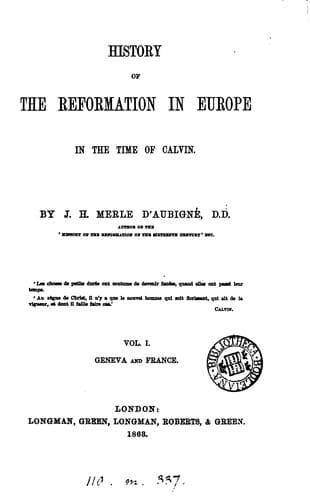
History of the Reformation in Europe in the Time of Calvin, Vol. 6 (of 8)Merle d'Aubigné, J. H. (Jean Henri)
History
History of the Reformation in Europe in the Time of Calvin, Vol. 6 (of 8)
Merle d'Aubigné, J. H. (Jean Henri)
Reformation
Wishart answered, ‘This fire torments my body, but noways abates my
spirit.’ Then catching sight of the cardinal at the window with his
courtiers, he added, ‘He who in such state, from that high place,
feedeth his eyes with my torments, within few days shall be hanged out
at the same window to be seen with as much ignominy as he now leaneth
there in pride.’[356] Some authors consider these words, reported by
Buchanan, to be an instance of that _second sight_ with which they
allege the Scots to be endowed. Wishart, however, did not need an
extraordinary revelation to teach him that ‘the wicked goeth away in
his wickedness.’ He had hardly uttered those words when the rope was
tightened about his neck, so that he lost the power of speaking. The
fire reduced his body to ashes; and the bishops, full of steadfast
hatred of this servant of God, caused an order to be published that
same evening through all the town, that no one should pray for their
victim under the severest penalties. They knew what respect was felt
for him by many even of the Catholics themselves.
There are people who say that religion is a fable. A life and a death
such as those of Wishart show that it is a great reality.
CHAPTER XV.
CONSPIRACY AGAINST BEATOUN.--HIS DEATH.
(MARCH TO MAY 1546.)
[Sidenote: FEELING CONCERNING WISHART’S DEATH.]
The death of Wishart excited in Scotland feelings of very diverse
character. The bishops and their adherents extolled to the skies the
cardinal who, without troubling himself about the regent’s authority,
and suppressing the insolence of the people, had constituted himself
the defender of Rome and of the priesthood. ‘Ah,’ said they, ‘if the
Church had formerly had such champions, she would keep all things under
her dominion by the very force and weight of her majesty.’
Simple-hearted Christians lamented the martyrdom without a thought of
revenge. But one part of the people, and with them several of the most
eminent men, condemned aloud at table and everywhere the cardinal’s
cruelty, and declared that the blood which had been shed called for
vengeance. Even those who, without sharing Wishart’s views, were
actuated by just and generous sentiments, asked themselves what hope
they could have of preserving their liberties under the most cruel of
tyrants; under a prelate who made war alike on men and on God; who
pursued with his enmity every one that possessed wealth or was animated
by piety, and sacrificed them to his caprice like beasts taken from
the stall;[357] who gave his sanction to connections with worthless
mistresses, and dissolved lawful marriages at his pleasure; who in his
own house wallowed in debauchery with prostitutes, and out of doors, in
his wrath, revelled in the slaughter of innocent men and in the blood
of heretics.[358] Such is the portrait of Beatoun drawn by Buchanan.
Public-domain text, read in full here on John Shaqi.
Reviews
Reviews
No reviews yet
Be the first to share your thoughts on this work.
Elsewhere in the archive
Join the Discussion
Join the discussion
Sign in to leave a comment or review.
Sign InorCreate an account