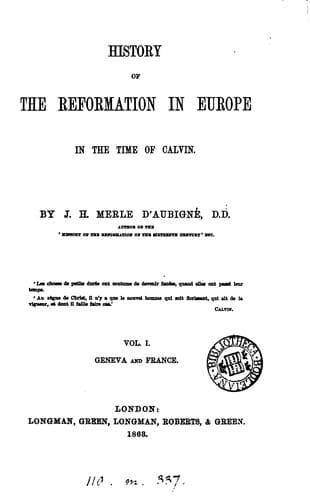
History of the Reformation in Europe in the Time of Calvin, Vol. 6 (of 8)Merle d'Aubigné, J. H. (Jean Henri)
History
History of the Reformation in Europe in the Time of Calvin, Vol. 6 (of 8)
Merle d'Aubigné, J. H. (Jean Henri)
Reformation
Nevertheless it was not Calvin alone, as some appear to believe,
who effected this great revolution. Had he come into the midst of a
people indolent and effeminate, such victories would not have been
won. But the Genevese had been preparing for centuries, by means of
the struggles which they had gone through, for the maintenance of
their liberty. A life of toil, incessant industry, and rude combats
had inured them to blows. Their souls had been elevated. They were
naturally keen and decisive; but that iron, already brilliant, had
acquired by tempering an inflexible hardness. The heroism of the
Huguenots of Geneva became one of the elements which contributed to
the triumph of the Reformation. The character of those strong men was
as essential to the work as coal is for the conversion of iron into
steel. It was not Calvin the individual, it was Geneva in its entirety,
that vanquished Rome. The energy of the Bertheliers, the Lévriers,
and of many others, was one of the ingredients of the moral energy
of which Geneva became the hearth, and which had almost disappeared
from history. The most earnest of the Genevese Huguenots joined the
reformer; the masses supported him; and some Frenchmen who had passed
through the sieve of persecution, worthy also to be called Huguenots,
gave the hand to the sons of Geneva. And when, after achieving its
triumph, the Reformation found itself attacked by a numerous and
powerful army, assembled under the banners of kings, of Ignatius
Loyola, and the pope, Geneva and the men of her school, who were found
in all parts of Christendom, were able to resist the hostile force, and
to say to it, ‘No further shalt thou go!’
[Sidenote: CALVIN RETAINED AT GENEVA.]
There was, indeed, in the struggle for the renewal of Christendom, one
will which conceived, one personality which acted, one voice which
resounded with a force till then almost unknown, and in a thousand
directions: it was, next to Luther’s, that of Calvin. But while a great
general is indispensable in the day of battle, so also is an army
trained by him for energetic conflict. The part which Geneva played
in the sixteenth century is not explained by the character of one man
alone, but by many concurrent circumstances both moral and political.
That army, created by a vivifying breath from on high, was soon in
action wherever a struggle became necessary. Those soldiers went forth
into the world, braved danger, displayed their colors, and proclaimed
salvation, until at length Rome gave them the martyr’s death, and
God gave them the crown of immortality. CALVIN and the HUGUENOTS, that
is the great motto of the sixteenth century.
Public-domain text, read in full here on John Shaqi.
Reviews
Reviews
No reviews yet
Be the first to share your thoughts on this work.
Elsewhere in the archive
Join the Discussion
Join the discussion
Sign in to leave a comment or review.
Sign InorCreate an account