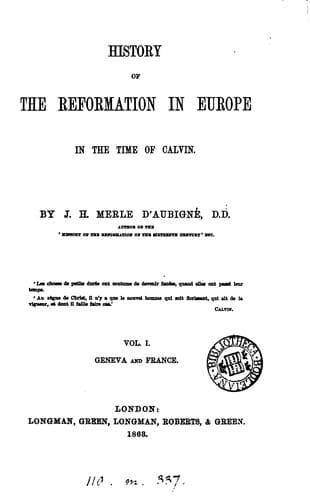
History of the Reformation in Europe in the Time of Calvin, Vol. 6 (of 8)Merle d'Aubigné, J. H. (Jean Henri)
History
History of the Reformation in Europe in the Time of Calvin, Vol. 6 (of 8)
Merle d'Aubigné, J. H. (Jean Henri)
Reformation
The vicar of Morges, Drogy, a man more enlightened than the others,
and who saw clearly the weakness of the Romish teaching, apologized
in the best way he could for his comrades, and made excuse for their
defeat. ‘The poor priests are ignorant,’ he said, ‘and they deserve to
be pitied. It is no great glory for the ministers to have beaten them.
What they want is time given them for study, and a long time too; but
instead of that they have been pitilessly bantered.’ ‘Do not take as
insults,’ said the amiable Viret, ‘the charitable admonitions which we
have given them. So far from wishing them any harm, we are ready to
shed our blood for their salvation.’ ‘No doubt,’ added the reformer
Marcourt, who had not hitherto spoken, a man of much good sense, but
somewhat more severe than Viret, ‘no doubt the poor priests deserve
to be pitied, but still more the poor people. No man would intrust a
flock of sheep to a shepherd who was blind and dumb; why then are the
churches placed under leaders who are blind and unable to explain the
Word of God?’[408]
[Sidenote: CALVIN AND HILDEBRAND.]
Calvin then rose to speak again, and without stopping to argue with
the feeble apologists of Rome, who were sufficiently refuted, he
selected for his adversary the most illustrious and the most valiant
of the champions of the papacy, the man who was indeed its chief
founder, Hildebrand, made pope under the name of Gregory VII. These
two men were well fitted to contend with equal strength in the lists.
It is a pity that five centuries stood in the way of their measuring
their forces hand to hand. It was Hildebrand who had launched over
Christendom these stupendous assertions, ‘that the name of the pope
is sole in the world,--that the Romish Church never did err and never
will err,--that the pope may depose the emperor, and that all princes
must kiss his feet.’[409] Calvin frequently contended against these
presumptuous lies,[410] and he had done so before this time, at least
to some extent. On this occasion he made use of a document written
by a cardinal, a contemporary of Hildebrand, which relates, among
other things, that that pope, wanting for once _to get through his
incantations_, took the bread which he affirmed to be God, and threw
it into the fire.[411] An occasion for the natural exclamation, ‘Say
now that the bread is your God!’ This story, told by a cardinal at
the expense of a pope, appears to us to be apocryphal. But it is quite
true, as we know from the relations which existed between Gregory VII.
and Berenger, that the famous pontiff had doubts about the doctrine of
transubstantiation, and that he did not pronounce himself in support
of it until he perceived that his enemies would take advantage of his
doubts on the subject to strike a blow at his hierarchical rights and
supreme authority.
Public-domain text, read in full here on John Shaqi.
Reviews
Reviews
No reviews yet
Be the first to share your thoughts on this work.
Elsewhere in the archive
Join the Discussion
Join the discussion
Sign in to leave a comment or review.
Sign InorCreate an account