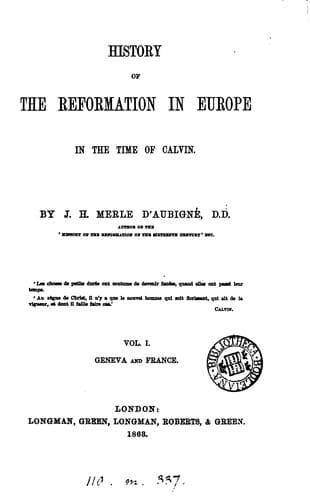
History of the Reformation in Europe in the Time of Calvin, Vol. 6 (of 8)Merle d'Aubigné, J. H. (Jean Henri)
History
History of the Reformation in Europe in the Time of Calvin, Vol. 6 (of 8)
Merle d'Aubigné, J. H. (Jean Henri)
Reformation
The Gospel met with opposition in the district of La Vaux, which lies
between Vevey and Lausanne. At a consultative meeting, held October
15, the deputies of La Vaux had demanded a general assembly, and had
declared that they would oppose ‘any innovation in the churches.’ Those
of Lutry, a small town bordering on Lausanne, were of the same mind.
But when the bailiff of Lausanne came three days after to dine there,
the wind began to change. The magistrates, flattered with this visit,
offered him with high compliments the wine of honor (_vin d’honneur_);
and all their zeal was limited to getting the papacy buried in the most
decorous manner possible. When the bailiff presented himself, November
2, to burn the images and destroy the altars, the municipal officers
demanded permission to remove them themselves, desiring to do it with
more delicacy. They caused the _Corpus Domini_ to be carried into the
_Grotto_, where they gave it an honorable position, and lighted lamps
just as if it were in the church. They also put there the vessel of
holy water, covering it up carefully. Some weeks later, January 16,
1537, there appeared, on the part of Berne, one Matthieu de la Croix,
a converted monk, a man of discretion and benevolence. He said to the
council, ‘I offer to preach, if you approve it, and even to preach
every day if you will assent to it; and further, when any one dies I
will deliver a sermon for the consolation of the family.’ Anxious still
more powerfully to work upon their hearts, he added, ‘I propose that a
request be addressed to the lords of Berne in favor of the poor.’ One
might fancy that De la Croix did nothing more than put in practice the
proverb, _More flies are to be caught with honey than with vinegar_.
But there is nothing to show that his gracious way did not proceed
from a sincere charity. This zeal for their commune touched the hearts
of the Lutry people, and they accepted the ministry of this man of
goodwill, and at the same time added to their acceptance the express
request to Berne to maintain the poor. On February 8, 1537, the church
was cleansed, and the stones of the altar were removed to a place
apart.[427]
[Sidenote: SEARCH FOR MINISTERS.]
Public-domain text, read in full here on John Shaqi.
Reviews
Reviews
No reviews yet
Be the first to share your thoughts on this work.
Elsewhere in the archive
Join the Discussion
Join the discussion
Sign in to leave a comment or review.
Sign InorCreate an account