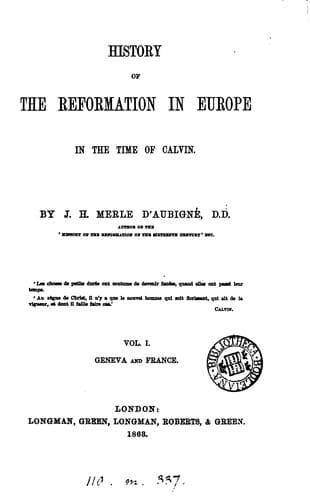
History of the Reformation in Europe in the Time of Calvin, Vol. 6 (of 8)Merle d'Aubigné, J. H. (Jean Henri)
History
History of the Reformation in Europe in the Time of Calvin, Vol. 6 (of 8)
Merle d'Aubigné, J. H. (Jean Henri)
Reformation
Calvin had displayed at Lausanne a steadfastness in the faith, and
a faculty of unfolding his views, which attracted more and more
attention to him. Bucer and Capito, in reading his _Institution_,
had already recognized the lofty reach of his intellect, and they
eagerly desired to have a conference with him on the evangelical
doctrine. They both wrote to him on December 1. ‘We acknowledge,’ said
Bucer, ‘that it is the Lord’s will to make use of you abundantly for
the good of our churches, and to make your ministry greatly useful.
We desire to be in agreement with you in all things, and we will go
to meet you wherever you please.’[438] Thus, then, the Strasburgers
acknowledged in Calvin a vocation for all the churches. They saw in him
the reformer. The author of the _Institution_ had in fact conceived
an ideal of a Church which was to take the place of the papacy--an
ideal difficult, perhaps impossible of realization in this world, but
to which he desired that Geneva should make as near an approach as
possible. Luther had announced with power the doctrine of remission of
sins, without concerning himself much about the constitution of the
Church. That doctrine, by penetrating the hearts of men, was to form
the congregation of the Lord. The great aim of Calvin was certainly to
proclaim before everything, like Luther, the redemption accomplished
by Jesus Christ, and the salvation which it gives; but he sought also,
more than the German reformer, to found a faithful Church, which, being
quickened and sanctified by the virtue of God’s word and the grace
of the Holy Spirit, should truly be the body of the Lord. Zwingli
had also busied himself with this subject; but there is an important
difference between the labors of the reformers of Zurich and Geneva.
At Zurich, Zwingli had looked downward: it was the people, so far as
they believed in the Scriptures, who were the foundation of the Church.
Calvin, on the other hand, looked upward, and placed the origin and the
subsistence of the Church in God himself. At Zurich, the Church existed
by the will of the reformed majority of the nation; at Geneva, it was
the will and the Word of God that formed it. At Zurich, the _fulcrum_
was in liberty; at Geneva, in authority. Both of these are salutary;
but each has its own danger. The best system is that in which authority
and liberty are combined; but this is not always easy to realize.
Public-domain text, read in full here on John Shaqi.
Reviews
Reviews
No reviews yet
Be the first to share your thoughts on this work.
Elsewhere in the archive
Join the Discussion
Join the discussion
Sign in to leave a comment or review.
Sign InorCreate an account