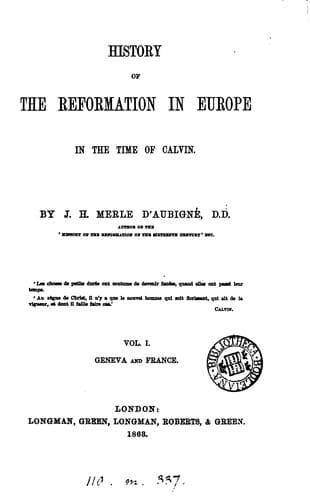
History of the Reformation in Europe in the Time of Calvin, Vol. 6 (of 8)Merle d'Aubigné, J. H. (Jean Henri)
History
History of the Reformation in Europe in the Time of Calvin, Vol. 6 (of 8)
Merle d'Aubigné, J. H. (Jean Henri)
Reformation
The school, placed under the direction of Saunier, likewise flourished.
Lessons began at five o’clock in the morning.[473] The pupils were
instructed ‘in the three most excellent languages, Greek, Hebrew,
and Latin, in addition to the French, which, in the opinion of the
learned, is by no means to be despised.’ Mathurin Cordier, formerly
Calvin’s teacher, soon devoted himself to this task. Numerous scholars,
attracted to Geneva by the great work which was being achieved there,
came from Basel, Berne, Bienne, Zurich, and other places, to study
there. These messmates lived at the College, with Saunier, whose house
was ordered in a Christian manner. ‘Daily, before they sat down to
meat, one of them read aloud a chapter of the Bible and all the rest
listened. While seated at the table, they each repeated a sentence
of Holy Scripture.’[474] Thus were fashioned the strong men of the
sixteenth century. The system which excludes from the school the Bible
and even religion, that is to say, the regenerative and training
element, will never form the like.
[Sidenote: DISCIPLINE.]
The reformers, whose intercourse with each other was pleasant and
refreshing, enjoyed in addition the approval of the majority of
the people, and particularly of the magistrates. Receiving so much
encouragement in their ministry, they were brave, active, and
unwearied in their calling. Far from being weighed down with their
great task, they appeared rather to grow stronger under the burden;
and this is a distinctive mark of great men. If any difficulty arose,
if any village were in need of a preacher, Farel and Calvin applied
with confidence to the council, which usually acceded to their request,
and acted even with generosity.[475] When a good citizen pointed out,
February 13, that Calvin had not yet received anything, the council
decreed to present him with _six écus_.[476] The next day, Farel, with
his brother and Saunier, applied for the grant of citizenship; it was
resolved that they should receive it free of charge. Calvin did not
become a citizen of Geneva till a later period. Nor was he the only
one who deferred that matter. Other celebrated Frenchmen declined the
citizenship of Geneva, their city of refuge, on the ground that they
could not renounce France. That love for the old country was probably
one of the motives which led Calvin to put off for three-and-twenty
years becoming a citizen of the city of which he was the very soul. On
February 27 they presented to Saunier thirty measures of wheat; and, on
June 6, _six écus_ to Courault. The gifts were not large, but every age
has its own measure.
Public-domain text, read in full here on John Shaqi.
Reviews
Reviews
No reviews yet
Be the first to share your thoughts on this work.
Elsewhere in the archive
Join the Discussion
Join the discussion
Sign in to leave a comment or review.
Sign InorCreate an account