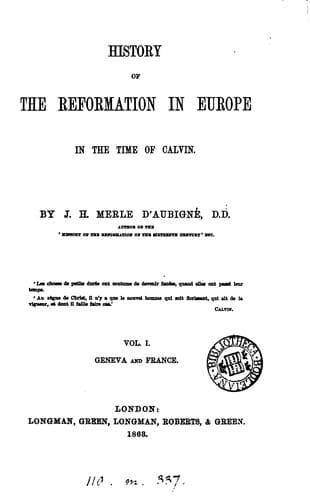
History of the Reformation in Europe in the Time of Calvin, Vol. 6 (of 8)Merle d'Aubigné, J. H. (Jean Henri)
History
History of the Reformation in Europe in the Time of Calvin, Vol. 6 (of 8)
Merle d'Aubigné, J. H. (Jean Henri)
Reformation
The peace and satisfaction which were the fruit of the settled order,
and even of the beauty of the places in which these great changes had
been effected, did not long remain undisturbed. Some foreign doctors
came to Geneva, Herman of Liége and Andrew Benoît, the latter also a
native of the Netherlands, both of them belonging to that enthusiastic
sect, some of whose leaders Calvin had previously encountered
in France, and who called themselves the Spirituals.[481] These
sectaries had found their way into western Europe, but Germany and the
Netherlands were, above all, their proper countries. The German mind
has a philosophical and even mystical tendency, which gives rise to a
longing to penetrate deeper than the Bible itself into the knowledge
of divine things. The central position of Geneva, the important
revolution in politics and religion which had just been accomplished
there, excited in those sectaries the hope of establishing themselves
in the city for the purpose of spreading themselves afterwards over
France, Italy, and other countries. These new doctors, from the time of
their arrival, had labored to diffuse their opinions, and had gained
partisans. Among these were some members of the council.[482] Proud of
this first success, they expected to substitute in Geneva their dreams
for the Gospel. The claim set up by these Spirituals, of penetrating
further into the truth than the reformers did, gave them a certain
attractiveness for minds eager for novelties. They boldly announced
that they were willing to dispute with the preachers. As early as March
9 they were called before the council, and were invited to communicate
in writing the articles which they intended to maintain.[483] Herman
and Benoît complied with this request, and delivered their theses to
the council. The council took them into consideration on March 13. In
calling themselves the _Spirituals_, these men meant to assert that the
spirit alone acted in them. Their doctrine was a more or less gross
kind of Pantheism. They did not think, in general, ‘that the soul was
a substance, a creature having essence; it was merely, in their view,
the property which a man has of breathing, of moving, and of performing
other vital actions.[484] They said that in place of our souls it is
God who lives in us, and does in us all the actions pertaining to
life. God became the creature,’ adds Calvin, ‘and the latter was no
longer anything.’[485] An assassination having been committed at Paris,
Quintin, a leader among the Spirituals, replied to some who asked him
who committed it, ’Tis thou, ’tis I, ’tis God, for what thou and I
do, ’tis God that does it.’ They had also peculiar ideas respecting
Jesus Christ. They did not hold that he had been very man, but made
him a kind of phantom, as to his body. They held similar errors about
baptism, excommunication, the magistrate, oaths, and other matters.
We are not in possession of the articles which they presented to the
Public-domain text, read in full here on John Shaqi.
Reviews
Reviews
No reviews yet
Be the first to share your thoughts on this work.
Elsewhere in the archive
Join the Discussion
Join the discussion
Sign in to leave a comment or review.
Sign InorCreate an account