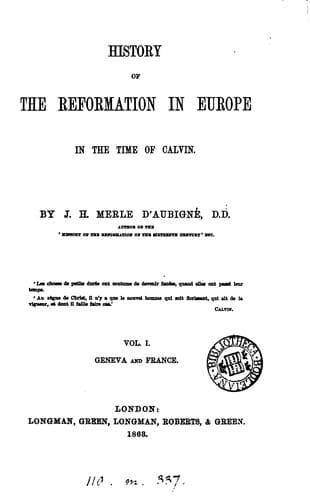
History of the Reformation in Europe in the Time of Calvin, Vol. 6 (of 8)Merle d'Aubigné, J. H. (Jean Henri)
History
History of the Reformation in Europe in the Time of Calvin, Vol. 6 (of 8)
Merle d'Aubigné, J. H. (Jean Henri)
Reformation
Those of the Genevese who had taken them from the time of their coming
for good evangelical Christians had called them _brethren_. But these
foreigners had shown themselves very quarrelsome; and having refused
even to pray with the Christians of Geneva--an offensive sign of their
sectarian spirit--they were no longer called by the name of brethren.
However, no penalty was at that time imposed on them, in the hope
that they might be brought to more Christian sentiments. But that was
indulging in a mere illusion. It was therefore decreed, according
to the custom of the age, that these doctors, and every member of
their sect, should be banished for ever from Geneva, under pain of
death. ‘The most admirable feature of this business,’ said the early
biographers of Calvin, ‘is, that if some churches of Germany have been
delivered from these doctors, they were so by mere rigor of justice;
while at Geneva _the magistrate had no hand in it_.’[490] Certainly,
he did not employ against them either imprisonment or torture; Calvin
endeavored only to convince them by argument. But banishment, under
pain of death, is nevertheless a very palpable act of the magistrate.
On the other hand, it is also a mistake to say that the Registers
knew nothing of Calvin’s victory.[491] On the contrary, the decree of
the council was expressly based on the fact that the doctors had been
unable to prove the truth of their propositions by Holy Scripture.
These were not the only attacks which the reformers had to sustain at
the outset of their career. There were certain restless spirits who saw
with vexation Calvin, Farel, and Viret at the head of the Reformation
in French-speaking lands, and who wished to deprive them of their
position, that they might occupy it themselves. These new troubles,
caused by jealousy and ambition, were of a sharper kind, and lasted
longer.[492] Their originator was that doctor of the Sorbonne, Caroli,
whom we saw arrive from France at Geneva at the time of the great
disputation of 1535.[493] Caroli was a sort of theological adventurer.
He did not at heart care for the sacred end which the Reformation had
in view. An incurable levity, which would not allow him to adhere
to any party, a liking for anything which seemed to him new and
fashionable, a burning thirst for glory and for fortune, a craving for
liberty to satisfy his vicious inclinations, these were the feelings
which actuated him, and threw him into a camp which he soon abandoned
to seek in another the gratification of the same evil desires. Vain,
proud, cringing, and inconsistent, he appeared as an assailant of the
monks when a sort of reformation was in vogue in France. Next, when
the era of persecution had begun, he made his escape to Geneva. The
object of his dreams was to become a sort of bishop, to govern the
reformed churches in French Switzerland; and he proposed to establish
a doctrine which should hold a middle place between the Gospel and the
pope.
Public-domain text, read in full here on John Shaqi.
Reviews
Reviews
No reviews yet
Be the first to share your thoughts on this work.
Elsewhere in the archive
Join the Discussion
Join the discussion
Sign in to leave a comment or review.
Sign InorCreate an account