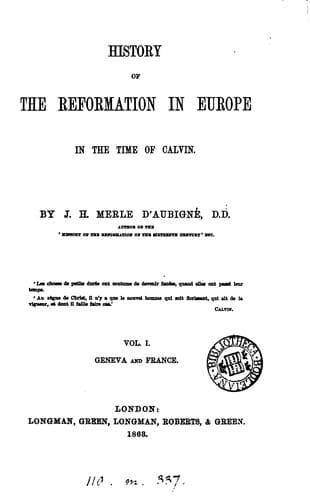
History of the Reformation in Europe in the Time of Calvin, Vol. 6 (of 8)Merle d'Aubigné, J. H. (Jean Henri)
History
History of the Reformation in Europe in the Time of Calvin, Vol. 6 (of 8)
Merle d'Aubigné, J. H. (Jean Henri)
Reformation
Many friends of the Gospel looked to Calvin, who enjoyed their entire
confidence, and begged him to go immediately to Lausanne. This he did.
Farel would have liked to accompany him; but the Bernese requested
him to look after his own church and not after theirs. Delegates from
Berne were sent to Lausanne, and a kind of consistory was thus formed,
in which Calvin, it appears, stated the case. But the proud Caroli,
who thought it beneath his dignity to make any defence, refused in the
haughtiest manner to give the least explanation of his conduct. He was
greatly annoyed to find himself accused by Calvin, whose superiority
was so troublesome to him. He immediately formed his plan. He resolved
to turn against the reformer the sword with which the latter had
threatened him, and to plunge it into him up to the hilt. ‘If the
minister of Geneva,’ he exclaimed, ‘has shown so much zeal in bringing
this business before your assembly, it is a shameful conspiracy, the
only object of which is to ruin me completely.’ Viret then spoke, and
so clearly set forth the subterfuges and calumnies of Caroli, that
the assembly condemned him to make a retractation, regardless of his
_amour propre_. Astounded by a sentence so severe, this man, who so
easily passed from one extreme to another, humbled himself, and with
lamentings and tears asked for pardon. Calvin was touched by this
demeanor, and in the abundance of his moderation prayed the assembly to
spare Caroli the act which wounded his pride. Viret did the same. Their
request was granted. The doctor of the Sorbonne had then nothing better
to do than to retire quietly to his own house, with a grateful feeling
towards his two noble adversaries. But their well-meant interposition
had not really softened him; his humility was a mere feint. He was
determined at all cost to reach his end and become the foremost man in
the Church. Jealous of the influence exercised by Calvin, Farel, and
Viret in Switzerland, he said to himself that in order to get firmly
seated in the saddle, the man already riding must first be dismounted.
The ruin of these three doctors was the task which he had to undertake.
He felt sure of the secret support, at least at Geneva, of some of the
leading men; and he flattered himself that he should be able to involve
Calvin in hopeless embarrassment.[499] He resolved therefore to assume
the character of accuser, and to reduce his enemies to play the part of
the guilty and the accused.
Public-domain text, read in full here on John Shaqi.
Reviews
Reviews
No reviews yet
Be the first to share your thoughts on this work.
Elsewhere in the archive
Join the Discussion
Join the discussion
Sign in to leave a comment or review.
Sign InorCreate an account