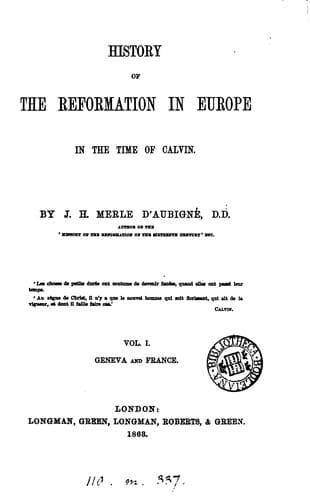
History of the Reformation in Europe in the Time of Calvin, Vol. 6 (of 8)Merle d'Aubigné, J. H. (Jean Henri)
History
History of the Reformation in Europe in the Time of Calvin, Vol. 6 (of 8)
Merle d'Aubigné, J. H. (Jean Henri)
Reformation
However, Calvin’s attention was at this time attracted and absorbed by
other objects. The disturbances which were agitating Geneva did not
arise exclusively from religious doctrines. The opposition wanted to
get into power; and if it succeeded, the days of the Reformation were
apparently numbered. The leaders acted prudently, but they could not
restrain the restlessness of their adherents. There were two entirely
distinct parties in the republic. The one aimed at any cost to take the
government out of the hands of the syndics and councillors who favored
the reformers, and to occupy their place; the other wished to appoint
magistrates who would persevere in the course on which the council had
entered. The two parties were now face to face. The attacking party
marched to the assault with decision and much noise, determined to come
to blows if necessary. ‘Insults and outcries were multiplied throughout
the town, both by night and by day.’[568] Excitement was daily becoming
more intense. ‘Next Sunday syndics are to be appointed,’ it was said;
‘there will be strife; we must go to the election in arms.’ One of the
most furious of the opponents, who carried leeks in his hat, cried out,
‘To-day we are wearing _green_ gillyflowers, but the day will make
plenty of _red_ heads.’[569] These symptoms alarmed not only the aged
and the sick, but also moderate men, who are sometimes a little timid.
To make use of menaces in order to keep citizens of the opposite party
from voting, is commonly enough the practice of a blind demagogy. It
gained its end. These violent speeches greatly grieved the pastors.
Fearing that blood would be shed, they appeared, February 1, two days
before the election, before the Council of the Two Hundred, and made
a wise (_belle_) remonstrance. The lieutenant of police, Henriod
Dumolard, one of the champions of freedom, who enjoyed general respect,
confirmed these fears ‘from good information.’ The council determined
to imprison those who had threatened to shed blood, and to take other
measures for the purpose of preventing on the appointed day either
tumult or conflict.
Public-domain text, read in full here on John Shaqi.
Reviews
Reviews
No reviews yet
Be the first to share your thoughts on this work.
Elsewhere in the archive
Join the Discussion
Join the discussion
Sign in to leave a comment or review.
Sign InorCreate an account