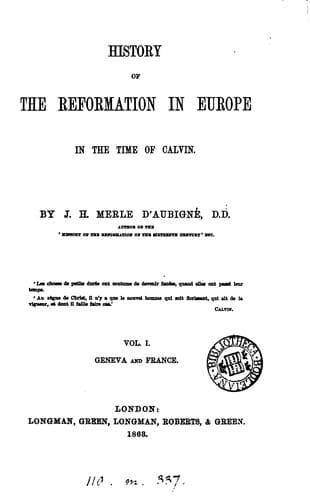
History of the Reformation in Europe in the Time of Calvin, Vol. 6 (of 8)Merle d'Aubigné, J. H. (Jean Henri)
History
History of the Reformation in Europe in the Time of Calvin, Vol. 6 (of 8)
Merle d'Aubigné, J. H. (Jean Henri)
Reformation
thus to a friend, to Bucer. He said to him, ‘If I speak so freely to
you, it is because I know to whom I am writing.’ But it was hardly
possibly that Kunz should not hear from some one what Calvin thought
of him. He became his mortal enemy, and he cherished the like hatred
towards the other ministers of Geneva.[584] He let no opportunity
escape him of opposing them. It was to no purpose that the Genevese
sought to show him that they were not his enemies, and to appease him
by their moderation. It was gratifying to him to appoint ministers in
the Bernese territories about whom Calvin had expressed himself in the
severest manner;[585] and when competent men had been examined and
approved at Geneva, he would not receive them until after they had been
re-examined by the Bernese classes.[586] Calvin however knew better
than Kunz. ‘What do such beginnings forebode?’ exclaims Calvin; ‘while
he fancies that he is inflicting lashes on us he is in fact preparing
his own ruin. Assuredly, if that be the will of God, he will fall into
the pit which he has digged, rather than continue to be the cause of so
great troubles to the Church of Christ.’[587]
[Sidenote: RELATIONS OF CHURCH AND STATE.]
In addition to the question of Lutheranism, there was also that of
the relations between the Church and the State, which was a subject
of difference between Berne and the Genevese reformers. At Berne the
magistrate was considered, according to the views of Zwingli, the
representative of the members of the flock; he was the bishop; the
Church was a State Church. Calvin on the contrary, who had seen in
France how the state treated the Reformation, wished for the autonomy
of the Church. He did not indeed demand the complete separation of
Church and State, but he desired that each of these two societies
should have its own government. This was the end for which he was
striving, and Kunz, when once aware of it, was still more enraged. To
these two questions was added that of worship. On this matter, as on
others, Kunz was the ape of Luther, as Megander was of Zwingli. Calvin
was no imitator of either the one or the other, but adopted generally a
middle course. With respect to worship he wished for great simplicity.
Berne had retained certain Catholic usages. They baptized as formerly
in a baptistery; at Geneva they put away the font and made use of a
simple vessel. Berne, at the supper, used wafers and unleavened bread;
Geneva used common bread. Berne had retained several festivals, even
that of the Annunciation of the Virgin; Geneva celebrated none but the
Lord’s day, the Sunday.[588] Farel having found these usages, at least
in part, among the Vaudois, in the visit which he made to those valleys
in 1532, had introduced them at Geneva, and Calvin, finding them there,
had made no change.
Public-domain text, read in full here on John Shaqi.
Reviews
Reviews
No reviews yet
Be the first to share your thoughts on this work.
Elsewhere in the archive
Join the Discussion
Join the discussion
Sign in to leave a comment or review.
Sign InorCreate an account