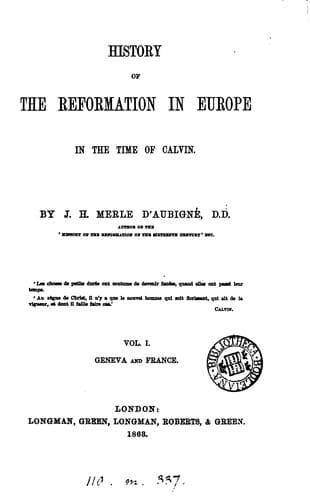
History of the Reformation in Europe in the Time of Calvin, Vol. 6 (of 8)Merle d'Aubigné, J. H. (Jean Henri)
History
History of the Reformation in Europe in the Time of Calvin, Vol. 6 (of 8)
Merle d'Aubigné, J. H. (Jean Henri)
Reformation
The synod met at Lausanne, March 31. The temper of the Bernese was more
dictatorial than conciliatory. The lords of Berne had indeed requested
that Calvin and Farel should go to Lausanne; but instead of expecting
of the assembly a work of conciliation, they had positively stipulated,
in a letter to the council of Geneva, that the Genevese preachers must
pledge themselves beforehand to adopt the order of worship established
at Berne; and that on this condition only would they be allowed to take
part in the deliberations of the synod. If their adhesion were not
given before the meeting, they should be heard afterwards and should
be separately treated with. The Genevese reformers, therefore, were
invited neither to a free assembly nor a free discussion. No other
right was conceded to them but that of submission. The Bernese added
that the motive of this strange proceeding was to avoid giving their
neighbors an opportunity of slandering the reformed religion, and to
promote the union of the Churches. But the latter object, and through
it the former, too, would probably have been more promptly attained by
treating the ministers of Geneva in a brotherly and not in a despotic
spirit. ‘The Bernese,’ according to Rozet, ‘inquired in a friendly
way of Farel and Calvin on their arrival, whether they accepted their
ceremonial.’ The reformers replied ‘that the subject was well deserving
of discussion.’ Discussion was refused to them.[591]
The Bernese senate had named Kunz one of the presidents of the synod.
Associated with him were the ministers of Erasmus Ritter, and two
members of the great council, Huber and Amman. Kunz was one of those
overbearing characters which inspire awe in other men, and whose
influence is almost irresistible. His colleagues, moreover, were in
agreement with him. The affair did not encounter any difficulty. The
synod, which opened on March 31, unanimously accepted the usages of
Berne,--the baptisteries, the unleavened bread at the supper, and the
festivals, including that of the Annunciation of the Virgin.
Public-domain text, read in full here on John Shaqi.
Reviews
Reviews
No reviews yet
Be the first to share your thoughts on this work.
Elsewhere in the archive
Join the Discussion
Join the discussion
Sign in to leave a comment or review.
Sign InorCreate an account