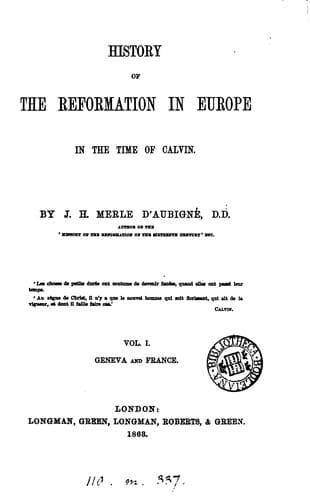
History of the Reformation in Europe in the Time of Calvin, Vol. 6 (of 8)Merle d'Aubigné, J. H. (Jean Henri)
History
History of the Reformation in Europe in the Time of Calvin, Vol. 6 (of 8)
Merle d'Aubigné, J. H. (Jean Henri)
Reformation
The council met after the departure of the reformers and their friends,
and again decided that the Lord’s supper should be celebrated the
next day, Easter Sunday, according to the rites established at Berne,
and not according to those of Geneva; and it decreed that, if the
ministers still refused to celebrate it, they should be forbidden to
preach. One cannot but be astonished at this decision, and at the
mean spirit which it displays on the part of the council. Simple and
evangelical usages had been established in Geneva: the citizens had
been called upon to take an oath in St. Peter’s church to a confession
of faith which in its spirit is entirely in agreement with those
practices; and now, in a matter which but little concerns it, in order
to gratify the lords of Berne, whom it could easily resist when it
chose to do so, the council determined to compel the ministers to
observe a ceremony essentially Judaic,[609] even at the risk of seeing
worship suspended and the Church overthrown. This looks very much like
a pretext, good or bad, which they laid hold of for the purpose of
getting rid of the reformers. The chief-usher went in the afternoon
to the pastors to communicate the decree to them. He did not find
Farel, but Calvin, learning from the officer that the civil magistrate,
without waiting for the resolution of the synod of Zurich, was himself
deciding this ecclesiastical question, just as if it were an affair of
military orders to give to an officer, refused to accept the order.
Thereupon the chief-usher, in the name of the council, prohibited his
preaching.[610]
What to do? This was the question which Calvin put to himself. He
longed for unity and peace in Geneva. He appealed afterwards to the
Genevese themselves. ‘We take God to witness,’ said he, ‘and your own
consciences, in the light of his countenance, that while we have been
among you all our exertions have been directed towards preserving you
in happy union and pleasing concord. But those who had a mind to form
a party by themselves have separated from us, and have introduced
division in your Church and in your city.’[611] Lambert’s exclamation,
when he spoke aloud of _traitors_ and _false witnesses_, is sufficient
to show us what was the state of Geneva at that time. Concord was
nothing more than a lovely dream. The most violent passions were called
into play. One would have said that God was giving up the inhabitants
of the city to the unruly motions of their own hearts; and that is the
most terrible chastisement which he ever employs in the punishment of
men. Not, indeed, that these motions showed themselves violent alike in
all. The lower classes were agitated, like their lake when the north
wind, blowing impetuously, lifts up the waves and dashes them furiously
on the rocks, the walls, and the banks. But among other classes
appearances were better kept up. Nevertheless, if any reason were still
left, it was too often only passion that made use of it for its own
ends.
Public-domain text, read in full here on John Shaqi.
Reviews
Reviews
No reviews yet
Be the first to share your thoughts on this work.
Elsewhere in the archive
Join the Discussion
Join the discussion
Sign in to leave a comment or review.
Sign InorCreate an account