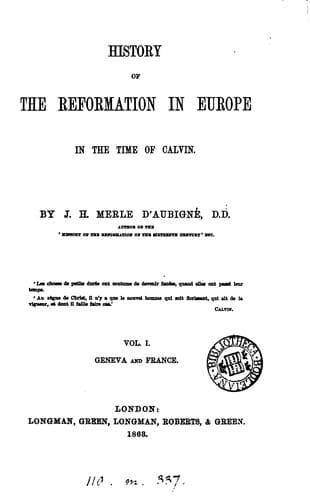
History of the Reformation in Europe in the Time of Calvin, Vol. 6 (of 8)Merle d'Aubigné, J. H. (Jean Henri)
History
History of the Reformation in Europe in the Time of Calvin, Vol. 6 (of 8)
Merle d'Aubigné, J. H. (Jean Henri)
Reformation
Thus was fulfilled a prophecy of Bonivard, uttered ten years before. It
will be remembered that in 1528 some of the Genevese, who were desirous
of the Reformation only that they might get rid of the priests, with
their vices and their superstitions, having declared to the prior
of the depraved ecclesiastics of St. Victor that they wished to put
in their place ministers of the Gospel who would introduce a true
Christian Reformation, Bonivard replied to them, ‘If you wish to reform
others, ought you not in the first place to reform yourselves? Animals
that live on the same meat naturally hate one another. It is just the
same with us. We are unchaste; so are you. We are drunkards; you are
the same. We are swearers, blasphemers; so are you. You want to drive
us away, you say, to put Lutheran ministers in our place.... Gentlemen,
take great care what you undertake to do. According to their doctrine,
a man will be prohibited from gaming and from giving himself up to
debauchery, and that under a heavy penalty. How that will vex you! You
will not have had them for two years before you will regret us.’[653]
Bonivard spoke candidly and even rudely, but his words fully confirm
the testimony and the complaints of Calvin, of Farel, and of Rozet.
It is all true, even to the time fixed by the prior--_not two years_.
Farel and Calvin undoubtedly showed themselves in this business subject
to human weaknesses. As they were both men of strong character, they
easily stimulated each other to an inflexibility to which they were
naturally inclined. Calvin himself tells us that the prudent Bucer,
at a later period, wished that they should not live together, lest
the influence which they had over each other should be hurtful to
them.[654] They have said themselves that they might have displayed
more gentleness. But it is impossible not to acknowledge that they did
what fidelity to the Gospel demanded of them. The question about the
bread was a little pennant raised by the councils, in opposition to
the great evangelical banner courageously borne by Calvin and Farel.
The two classes of combatants in this warm affair were representatives
of two systems which not only bore no resemblance to each other but
were diametrically opposed. If the reformers had given way, the great
cause of religion and of morals would have been injured, the dignity
of their ministry lowered, and their activity for the extension of
the kingdom of God in Geneva fettered, perhaps rendered impossible.
Their compliance in such a case would have been not only blameworthy,
it would have been blamed. It was for them the question of ‘To be or
not to be.’ They were bound to strive to win the victory; and if they
failed to conquer, then they were bound to suffer as witnesses to the
rejected truth. They had neglected no means of scaling the citadel,
and of planting on it their noble flag. They had failed, and it only
remained for them to retreat, conquered and yet in reality conquerors;
Public-domain text, read in full here on John Shaqi.
Reviews
Reviews
No reviews yet
Be the first to share your thoughts on this work.
Elsewhere in the archive
Join the Discussion
Join the discussion
Sign in to leave a comment or review.
Sign InorCreate an account