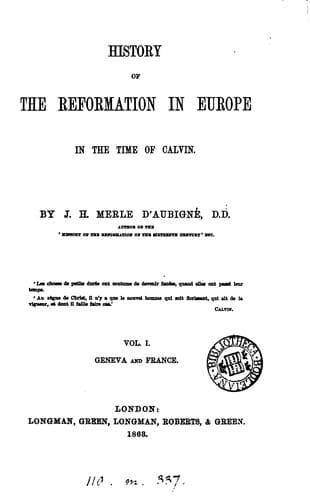
History of the Reformation in Europe in the Time of Calvin, Vol. 6 (of 8)Merle d'Aubigné, J. H. (Jean Henri)
History
History of the Reformation in Europe in the Time of Calvin, Vol. 6 (of 8)
Merle d'Aubigné, J. H. (Jean Henri)
Reformation
On Sunday, May 26, the general council of the citizens met. Louis
Amman and his colleague, Viret and Erasmus Ritter, appeared as
advocates for the two banished ministers. Amman spoke first. He showed
the great injustice involved in the banishment of these excellent
men. They had to do with Farel, who was justly designated the apostle
of French Switzerland, and with Calvin, the greatest theologian of
the age. He earnestly requested that they should be recalled, and
that, according to the rules of equity, their justification should be
heard, for it was not usual for any man to be condemned unheard. He
reminded them of the distinguished services of Farel, of the labors
and hardships which he had undergone for the good of that people. Was
it not Farel who, in 1532, standing in the midst of the council of
priests, had seen them rush at him and knock him down with their blows,
crying, ‘Kill him! kill him!’ One of their attendants had discharged
his arquebuse at him, and he had been driven from the town with threats
of being thrown into the Rhone. Since that time to what tribulations
had he not been exposed! Was it not incumbent on the people of Geneva
to testify their gratitude to him in some other way than by exile?
Then Amman spoke of the joy which the adversaries of the Reformation,
the subjects of the pope, would feel, and did already feel, to see
Geneva banishing her reformers, and he conjured the citizens not to
give them such an occasion of triumph and exultation. Next Viret spoke,
in his own name and in the name of his colleague Ritter; and we know
how well adapted the mild eloquence of this pious pastor was to soothe
exasperated spirits. The union of the pastors and the seriousness of
the ambassador in pleading the cause of the reformers did not fail to
make an impression. A large assembly is always susceptible of wholesome
impressions: there is in it a contagion of good. Hearts were moved, and
the disposition of many was changed. It was possible for the deputies
to suppose that the battle was won. As they were not to attend the
deliberations of the general council, they went out full of hope.[700]
[Sidenote: THE GENERAL COUNCIL.]
Public-domain text, read in full here on John Shaqi.
Reviews
Reviews
No reviews yet
Be the first to share your thoughts on this work.
Elsewhere in the archive
Join the Discussion
Join the discussion
Sign in to leave a comment or review.
Sign InorCreate an account