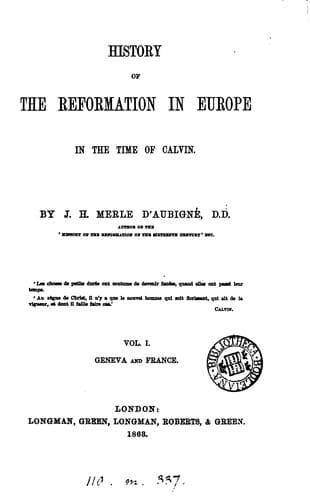
History of the Reformation in Europe in the Time of Calvin, Vol. 6 (of 8)Merle d'Aubigné, J. H. (Jean Henri)
History
History of the Reformation in Europe in the Time of Calvin, Vol. 6 (of 8)
Merle d'Aubigné, J. H. (Jean Henri)
Reformation
As soon as order was partially restored, the first syndic, Richardet,
a hot-tempered man, as we know, put to the vote the demand made by
the ambassadors of Berne; or rather, taking a less regular but more
artful course, proposed the rejection of the demand. ‘Let all those,’
he said, ‘who wish that Farel, Calvin, and Courault should not enter
the town, hold up their hands.’ The secretary of the council said that
almost all hands were held up. This secretary was Ruffi, who had been
elected in the place of Claude Rozet on the very day of the banishment
of the reformers. His partiality was manifest in the fact that he wrote
at the same time that the fourteen articles contained some untruths;
untruths which the passionate Vandel himself had not been able to
detect. It was a piece of gratuitous falsehood, and imputations of
that kind do not inspire much confidence in anything that Ruffi might
report. After the voting, the first syndic requested that those who
wished the preachers to be readmitted to the town and to be heard
should hold up their hands. ‘A few were raised,’ said Michel Rozet, ‘to
signify that they wished for the ministers.’ The secretary named two
or three of them, amongst others Chautemps, in whose house Olivétan, a
kinsman of Calvin, had lived; but he added, ‘and certain others, few in
number.’ Timid men, in the presence of the storm which threatened to
break out, thought it prudent to be silent; some courage was required
to face it. In fact, at the mere sight of these few hands raised, a
transport of spite and wrath broke out; they could not endure an act of
independence, which was at the same time, with many there, an act of
respect for the reformers and the Reformation. _The rage was so great_,
says Rozet, _that the first two were compelled to fly_. Many pursued
them; some drew their swords; others, ‘glancing at them fiercely,’
cried out, _Kill them! kill them!_ ‘The majority of votes,’ say the
Registers, ‘decided that the preachers should not again be admitted
into the town.’ The people of Geneva thus adopted a resolution which,
if they had not repented of it, would have prevented light going forth
from that city, and would have thrown an obstacle in the way of its
greatness.[712]
Thus was the matter decided. _Alea jacta est._ The powerful party
which, in their contest with the pope, the bishop, and the princes
of Savoy, had taken for their flag liberty and the truth, and had
transformed Geneva into an evangelical republic, had quarrelled after
their victory, as very commonly happens, and those who did not wish for
the Gospel had remained conquerors. But the citizens, _few in number_,
who had made their voice heard in the general council, were not the
only ones who longed for a Christian republic. This minority gradually
increased, or rather dared to show itself. It continued united,
fervent, determined, active; and to it ultimately the victory was to be
given.
CHAPTER XIV.
Public-domain text, read in full here on John Shaqi.
Reviews
Reviews
No reviews yet
Be the first to share your thoughts on this work.
Elsewhere in the archive
Join the Discussion
Join the discussion
Sign in to leave a comment or review.
Sign InorCreate an account