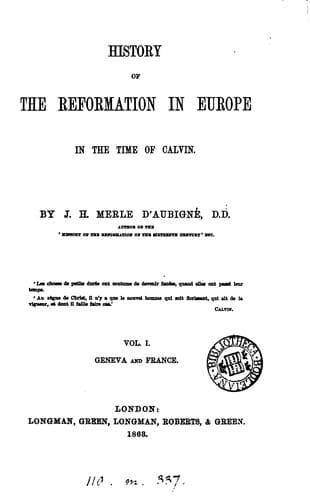
History of the Reformation in Europe in the Time of Calvin, Vol. 6 (of 8)Merle d'Aubigné, J. H. (Jean Henri)
History
History of the Reformation in Europe in the Time of Calvin, Vol. 6 (of 8)
Merle d'Aubigné, J. H. (Jean Henri)
Reformation
The government exerted itself to find substitutes for the two exiles.
The states of Berne and Neuchâtel gave up to it Jean Morand, pastor
at Cully,[738] on the shores of the lake of Geneva, and Antoine
Marcourt, of Lyons, pastor of Neuchâtel, who were installed about the
end of June. The council determined to give them, considering their
age and their large families, three hundred Genevese florins;[739]
the two Genevese each had two hundred and fifty florins. We became
acquainted with Marcourt at the synod of Lausanne. He had published
several treatises on the Eucharist, on the mass; to him likewise
were attributed the famous placards of 1534, which Florimond Raemond
believes to have been the work of Farel. The governor and councils of
Neuchâtel, in resigning Marcourt to Geneva, declared, June 18, ‘that
they had always found him a man of peace, one who desired, and to the
utmost of his power maintained, peace and public tranquillity.’ This
character seems hardly like that of the author of the _Placards_, one
of the most violent writings of the sixteenth century, which were
pronounced by the Roman Catholics[740] to be filled with ‘execrable
blasphemies and horrible threats against the king,’ and which gave rise
to that bloody persecution by the Valois and the Bourbons of which
the reformed Christians were the victims for more than two centuries.
However, we must confess that pacific men are not always consistent. It
would seem that Marcourt was not so much a man of peace as the people
of Neuchâtel had said; at least if we take literally what Calvin says.
‘How our successors will demean themselves,’ he wrote on August 4 to
Farel, ‘is a point on which we can form an opinion from their first
proceedings. They break off by their irritable temper every promise of
peace, and they seem to suppose that the best thing they have to do is
to tear to pieces both in public and in private the reputation which
we enjoyed, and to make us as hateful as possible.’[741] Calvin is
especially severe, perhaps too much so, with regard to the two Genevese
ministers. There was, however, some truth in the last touch in the
picture which he drew of them for Bullinger: ‘Both of them are very
ignorant, and when they open their mouths, it is to rave. This does not
prevent them from assuming an insolent pride.’[742]
[Sidenote: ACCUSATIONS.]
Public-domain text, read in full here on John Shaqi.
Reviews
Reviews
No reviews yet
Be the first to share your thoughts on this work.
Elsewhere in the archive
Join the Discussion
Join the discussion
Sign in to leave a comment or review.
Sign InorCreate an account