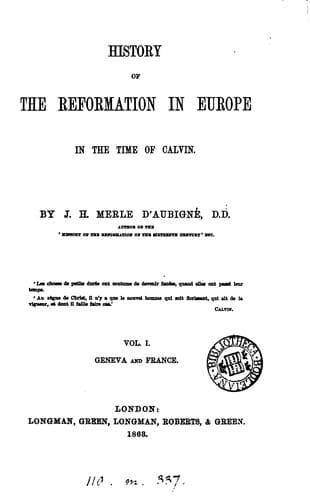
History of the Reformation in Europe in the Time of Calvin, Vol. 6 (of 8)Merle d'Aubigné, J. H. (Jean Henri)
History
History of the Reformation in Europe in the Time of Calvin, Vol. 6 (of 8)
Merle d'Aubigné, J. H. (Jean Henri)
Reformation
Charles V., after making peace with Francis I., had convoked, at
Frankfort, for the month of February 1539, a conference of evangelical
and Roman Catholic theologians, who were to endeavor to find a basis
of agreement. We have not to devote our attention to all the work done
at the German assemblies which Calvin attended, but only to that which
concerns him personally. Deputies from Strasburg went to Frankfort,
but the young French doctor did not accompany them. He contented
himself with earnestly commending to Bucer the cause of the persecuted
Protestants. But shortly after, having received a letter from Bucer,
informing him that he found it was impossible for him to do anything
for his co-religionists, and hearing at the same time that Melanchthon
was present at the conferences, his spiritual earnestness overcame
the timidity of his nature. He was seized with a strong desire to go
to Frankfort and to converse with the friend of Luther on religion
and the affairs of the Church. He set out in great haste the next
day. At Frankfort he met some of the most prominent characters of the
Reformation. Here were the pious John Frederick, elector of Saxony;
young Maurice of Saxony, who was one day to prove so formidable to
Charles V.; the famous landgrave Philip of Hesse, the Duke of Luneburg,
and many other princes, whose acquaintance could not be a matter of
indifference to the young reformer. Several of these young princes were
accompanied by a great number of knights and soldiers, and all appeared
to be full of courage for the defence of the Gospel. Calvin, in long
letters to Farel, gave an account of all that he saw and thought. He
formed a most just conception of the Protestant question in Germany, of
the disposition of the princes, of the policy of Charles V., and of the
various matters under discussion. But one man was there whose society
he coveted more than that of all the princes. Calvin’s sojourn at
Frankfort is especially marked by the conversations which he had with
Melanchthon ‘on many subjects.’[773] Several of the most influential
men of the Reformation, in Switzerland and in France, were not well
informed as to the opinions of this celebrated doctor. Calvin wished
to be able to bear testimony to them with certitude. The great idea of
the French doctor was agreement between all evangelical Christians.
He was convinced that it was necessary, not only for the sake of
obedience to the commandments of Jesus Christ, but further to promote
the triumph of the evangelical cause. He wished for union, not only of
the various parties in Germany, but of Germany and Switzerland. Now
Melanchthon appeared to him the fittest man to bring about agreement
among the Protestants. No sooner had these two great doctors met and
exchanged the most kindly greetings, than Calvin opened the question.
He had communicated to Melanchthon some articles in which his view
of the supper was set forth in a way to terminate dissension. ‘There
Public-domain text, read in full here on John Shaqi.
Reviews
Reviews
No reviews yet
Be the first to share your thoughts on this work.
Elsewhere in the archive
Join the Discussion
Join the discussion
Sign in to leave a comment or review.
Sign InorCreate an account