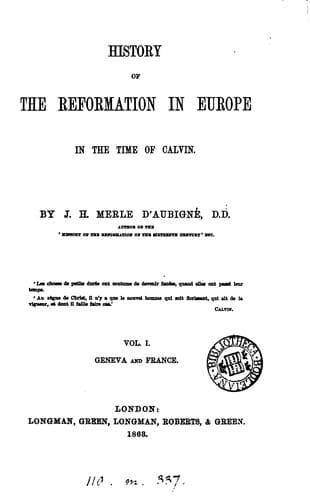
History of the Reformation in Europe in the Time of Calvin, Vol. 6 (of 8)Merle d'Aubigné, J. H. (Jean Henri)
History
History of the Reformation in Europe in the Time of Calvin, Vol. 6 (of 8)
Merle d'Aubigné, J. H. (Jean Henri)
Reformation
The reasoning of Sadoleto failed in its basis. He had confounded the
Reformation of the sixteenth century with the so-called reforms of the
preceding centuries. Those attempts, numerous enough, aimed at the
morals of the clergy and the abuses of the Church without attacking
the doctrine, and they miscarried. But the true Reformation directed
its efforts against the false doctrines of Rome, in order to put the
doctrine of the Gospel in its place. ‘It took the bull by the horns,’
as Luther says, and had him down. Liberal Catholics have imagined, that
if from the first such a course as Sadoleto’s had been adopted, the
course of the Reformation would have been entirely different.[792] But
they are mistaken, as the Bishop of Carpentras was, who, aiming his
blows at an enemy in the air, hit nothing but the air.
The council having heard the letter, very gladly accepted the
compliments paid to Geneva, sincerely thanked the cardinal’s messenger,
and charged him to say that a full reply should be sent in due
course. This was necessary, for the partisans of the pope in Geneva
praised the cardinal’s letter to the skies, and eagerly circulated
it in all directions. But there was no one able to answer it. The
pastors established by the government were not strong enough to
venture a struggle with Sadoleto. Morand himself, who was requested
by the council to undertake it, was incompetent. All those who in any
degree adhered to the Reformation were in a state of alarm, for they
understood that silence in this state of things would inevitably be a
great calamity to Geneva.[793]
It was on March 26 that the letter in which Sadoleto urged the Genevese
to forsake the Reformation had been delivered to the council, and on
the 27th this body resolved to reply to it in due time and place. On
the 28th several citizens appeared before the council; one of them,
François Chamois, demanding on their behalf that the confession of
faith of the Reformation which had been sworn at St. Peter’s, July 29,
1537, should be withdrawn from the possession of the former official
secretary, as contrary to their liberties; and that they themselves
should be released from the oath which they had taken to that
confession.[794] There is so intimate and evident a relation between
the proposal of Sadoleto and this proceeding of the citizens, the one
so punctually followed upon the other, that it is very difficult not
to suppose that the letter of the bishop had much to do in promoting
the requisition of Chamois and his friends. The audience given by the
council to the deputy of a cardinal, and the proposal of which he was
the bearer, were a matter so considerable and of such exciting interest
that the rumor of it could not fail to spread immediately in this town,
where people so habitually used to say, ‘What is the news? What is
talked of? What is going on?’
[Sidenote: IMMEDIATE CONSEQUENCES.]
Public-domain text, read in full here on John Shaqi.
Reviews
Reviews
No reviews yet
Be the first to share your thoughts on this work.
Elsewhere in the archive
Join the Discussion
Join the discussion
Sign in to leave a comment or review.
Sign InorCreate an account