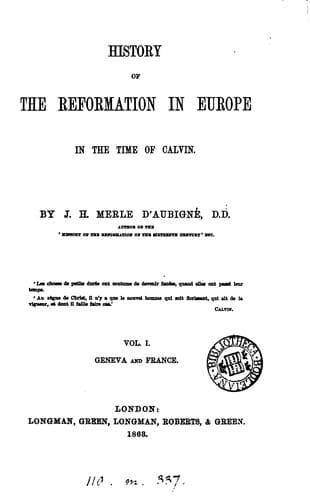
History of the Reformation in Europe in the Time of Calvin, Vol. 6 (of 8)Merle d'Aubigné, J. H. (Jean Henri)
History
History of the Reformation in Europe in the Time of Calvin, Vol. 6 (of 8)
Merle d'Aubigné, J. H. (Jean Henri)
Reformation
Beatoun did not hesitate: this bold preacher was evidently putting to
his mouth the trumpet of Hamilton and Alesius. The primate undertook to
obtain authority from the king to proceed against his confessor, and it
was an easier task than he imagined. Seaton, like John the Baptist, had
no dread of incurring the king’s displeasure, and had rebuked him for
his licentiousness. James had said nothing at the time, thinking that
the confessor was only doing his duty. But when he saw the archbishop
denouncing Seaton, ‘Ah,’ said this young prince, who was given up to
a loose life,[166] ‘I know more than you do of his audacity;’ and
from that time he showed great coolness towards Seaton. The latter
perceiving what fate awaited him, quitted the kingdom, and took refuge
at Berwick. It was about two years after the Lent sermon preached by
him in 1532.
He did not remain idle. He had a last duty to discharge to his master
the king. ‘The bishops of your kingdom,’ he wrote to him, ‘oppose our
teaching the Gospel of Christ. I offer to present myself before your
majesty, and to convince the priests of error.’[167] As the king made
him no answer, Seaton went to London, where he became chaplain to the
duke of Suffolk, brother-in-law of Henry VIII., and preached eloquently
to large audiences.
The King of England liked well enough to receive the friends of the
Gospel who were banished from Scotland. One priest, more enlightened
than the rest, Andrew Charteris, had called his colleagues children of
the devil; and he said aloud--‘If anyone observes their cunning and
their falsehood, and accuses them of impurity, they immediately accuse
him of heresy. If Christ himself were in Scotland, our priestly fathers
would heap on him more ignominy than the Jews themselves in old time
did.’ Henry desired to see the man, talked with him at great length,
and was much pleased with him. ‘Verily,’ said the king to him, ‘it is a
great pity that you were ever made a priest.’[168]
The clergy had now got rid of Hamilton, Seaton, and Alesius; but they
were nevertheless disquieted because they knew that the Holy Scriptures
were in Scotland. Notice was therefore given in every parish that ‘it
is forbidden to sell or to read the New Testament.’ All copies found in
the shops were ordered to be burnt.[169] Alesius, who was in Germany at
that time, was greatly afflicted, and resolved to speak.
[Sidenote: LETTER OF ALESIUS.]
Public-domain text, read in full here on John Shaqi.
Reviews
Reviews
No reviews yet
Be the first to share your thoughts on this work.
Join the Discussion
Join the discussion
Sign in to leave a comment or review.
Sign InorCreate an account