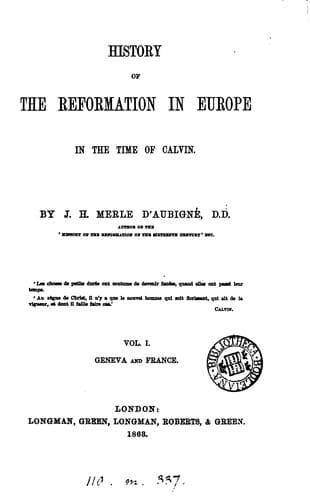
History of the Reformation in Europe in the Time of Calvin, Vol. 6 (of 8)Merle d'Aubigné, J. H. (Jean Henri)
History
History of the Reformation in Europe in the Time of Calvin, Vol. 6 (of 8)
Merle d'Aubigné, J. H. (Jean Henri)
Reformation
At the same time the Romish party was endeavoring to embroil Scotland
with England, and James was already engaging in several skirmishes. One
day, under the pretext of the hunt, he threw himself, with ‘a small
company’ of _three hundred persons_, on the estates the possession of
which was disputed by his uncle.[173] Shortly afterwards, four hundred
Scots invaded the Marches (frontier districts) at sunrise, and were
carrying off what they found there. Northumberland repulsed them, and
put to death the prisoners which fell into his hands. The Scots took
and burnt some English towns; the English invaded Scotland, and ravaged
its towns and country districts. The King of Scotland, intimidated,
applied to the pope and the King of France, and cried out for aid
with all his might. And then, in order to please at the same time the
priests, the pope, and Francis I., he took the advice of Cochlæus; with
the exception, that in Scotland the fire at the stake was substituted
for the waters of the Rhine.
[Sidenote: HENRY FORREST.]
A young monk, named Henry Forrest, who was in the Benedictine
monastery at Linlithgow, a man equally quick in his sympathies and
his antipathies, had been touched by Hamilton’s words, and uttered
everywhere aloud his regret for the death of that young kinsman of the
king, calling him a martyr. This monk was presently convicted of a
crime more enormous still: he was a reader of the New Testament. The
archbishop had him imprisoned at St. Andrews. One day a friar (sent by
the prelate) came to him for the purpose, he said, of administering
consolation; and offering to confess him, he succeeded by crafty
questions in leading the young Benedictine to tell him all he thought
about Hamilton’s doctrines. Forrest was immediately condemned to be
delivered over to the secular authorities to be put to death, and a
clerical assembly was called together for the purpose of degrading
him. The young friend of the Gospel had hardly passed the door where
the assembly was sitting, when, discovering the archbishop and the
priests drawn up in a circle before him, he became aware of what
awaited him, and cried out with a voice full of contempt, ‘Fie on
falsehood! fie on false friars, revealers of confession!’[174] When one
of the clerks came up to him to degrade him, the Benedictine, weary of
so much perfidy, exclaimed, ‘Take from me not only your own orders
but also your own baptism.’ He meant by that, says an historian, the
superstitious practices which Rome has added to the institutions of the
Lord. These words provoked the assembly still more. ‘We must burn him,’
said the primate, ‘in order to terrify the others.’ A simple-minded
and candid man who was by the side of Beatoun said to him in a tone of
irony, ‘My lord, if you burn him, take care that it be done in a cave,
for the smoke of Hamilton’s pile infected with heresy all who caught
the scent of it.’
Public-domain text, read in full here on John Shaqi.
Reviews
Reviews
No reviews yet
Be the first to share your thoughts on this work.
Join the Discussion
Join the discussion
Sign in to leave a comment or review.
Sign InorCreate an account