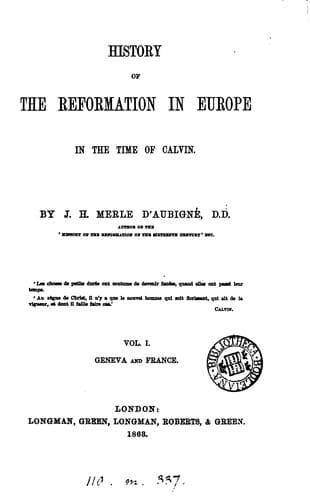
History of the Reformation in Europe in the Time of Calvin, Vol. 6 (of 8)Merle d'Aubigné, J. H. (Jean Henri)
History
History of the Reformation in Europe in the Time of Calvin, Vol. 6 (of 8)
Merle d'Aubigné, J. H. (Jean Henri)
Reformation
Straiton was carried off to Edinburgh, and cast into prison.
There was another Scotchman, Norman Gourlay, who after taking holy
orders had travelled on the continent, and had there been enlightened
by the word of the Gospel. Convinced that ‘marriage is honorable in
all,’ Gourlay had married on his return to Scotland; and when a priest
reminded him of the prohibition by Rome, ‘The pope,’ replied he, ‘is no
bishop, but an Antichrist, and he has no jurisdiction in Scotland.’
On August 26, 1534, these two servants of God were led into a hall of
Holyrood Abbey. The judges were seated, and with them the king, who,
appareled in red from head to foot, seemed to be there for the purpose
of assisting them. James V. pressed these two confirmed Christians
to abjure their doctrines. ‘Recant; burn your bill,’[181] he said to
them; but Straiton and Gourlay chose rather to be burnt themselves. The
king, affected and giving way, would fain have pardoned them; but the
priests declared that he had no authority to do so, since these people
were condemned by the Church. In the afternoon of August 27 a huge pile
was lit on the summit of Calton Hill, in order that the flames might
be visible to a great distance; and the fire devoured these two noble
Christians. If the Reform was afterwards so strong in Scotland it was
because the seed was holy.
Enough however was not done yet. All these heresies, it was thought,
proceed from Hamilton; his family must therefore be extirpated from the
Scottish soil. But Sir James, a good-natured man, an upright magistrate
and a lover of the Gospel, was for all that not in the humor to let
himself be burnt like his brother. So, having received one day an order
to appear before the tribunal, he addressed himself immediately to the
king, who had him privately told not to appear. Sir James therefore
quitted the kingdom; he was then condemned, excommunicated, banished,
and deprived of his estates, and he lived for nearly ten years in
London in the utmost distress.
[Sidenote: TRIAL OF CATHERINE HAMILTON.]
Public-domain text, read in full here on John Shaqi.
Reviews
Reviews
No reviews yet
Be the first to share your thoughts on this work.
Elsewhere in the archive
Join the Discussion
Join the discussion
Sign in to leave a comment or review.
Sign InorCreate an account