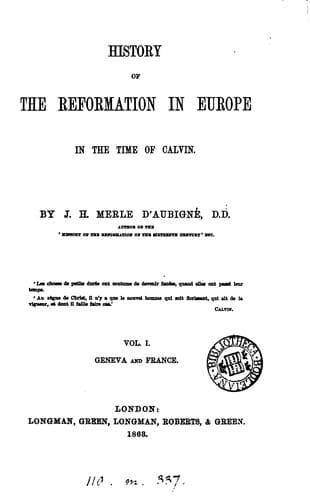
History of the Reformation in Europe in the Time of Calvin, Vol. 6 (of 8)Merle d'Aubigné, J. H. (Jean Henri)
History
History of the Reformation in Europe in the Time of Calvin, Vol. 6 (of 8)
Merle d'Aubigné, J. H. (Jean Henri)
Reformation
His sister Catherine was both a warm-hearted Scotchwoman and a decided
Huguenot. She would not make her escape, but appeared at Holyrood in
the presence of the ecclesiastical tribunal and of the king himself.
‘By what means,’ they said to her, ‘do you expect to be saved?’--‘By
faith in the Saviour,’ she replied, ‘and not by works.’ Then one
of the canonists, Master John Spence, said at great length--‘It is
necessary to distinguish between various kinds of works. In the first
place, there are works of _congruity_, secondly, there are works of
_condignity_. The works of the just are of this latter category, and
they merit life _ex condigno_. There are also _pious_ works; then works
of _supererogation_;’ and he explained in scholastic terms what all
these expressions meant. These strange words sounded in Catherine’s
ears like the noise of a false-bass (_faux-bourdon_). Wearied with this
theological babbling, she got excited, and exclaimed--‘Works here,
works there.... What signify all the works?... There is one thing alone
which I know with certainty, and that is that no work can save me,
except the work of Christ my Saviour.’ The doctor sat amazed and made
no answer, while the king strove in vain to hide a fit of laughter. He
was anxious to save Catherine, and made a sign for her to come to him;
he then entreated her to declare to the tribunal that she respected the
Church. Catherine, who had never had a thought of setting herself in
rebellion against the higher powers, gave the king leave to say what he
wished, and withdrew first into England, then to France. She probably
entered the family of her husband,[182] who, during his lifetime, was a
French officer in the suite of the duke of Albany.
But these punishments and banishments did not put an end to the storm.
Several other evangelical Christians were also obliged at that time
to leave Scotland. Gawin Logie, a canon of St. Andrews, and principal
regent of St. Leonard’s College, at which Patrick Hamilton had
exercised so powerful an influence, had diffused scriptural principles
among the students to such an extent that people were accustomed to
say, when they would make you understand that anyone was an evangelical
Christian, ‘He has drunk at the well of St. Leonard’s.’ Logie quitted
Scotland in 1534. Johnston, an Edinburgh advocate, Fife, a friend of
Alesius, M’Alpine, and several others had to go into exile at the same
time. The last-named, known on the continent by the name of Maccabæus,
won the favor of the King of Denmark, and became a professor at the
university of Copenhagen.
CHAPTER VIII.
THE KING OF SCOTLAND BREAKS WITH ENGLAND, AND ALLIES HIMSELF WITH
FRANCE AND THE GUISES.
(1534-1539.)
[Sidenote: BREAK WITH ENGLAND.]
Public-domain text, read in full here on John Shaqi.
Reviews
Reviews
No reviews yet
Be the first to share your thoughts on this work.
Elsewhere in the archive
Join the Discussion
Join the discussion
Sign in to leave a comment or review.
Sign InorCreate an account