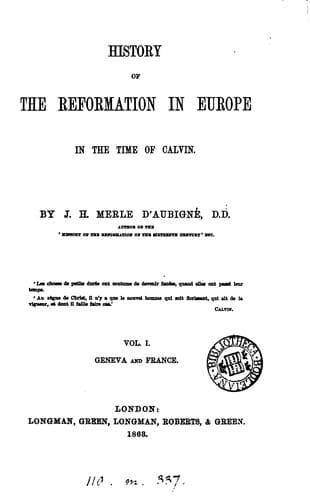
History of the Reformation in Europe in the Time of Calvin, Vol. 6 (of 8)Merle d'Aubigné, J. H. (Jean Henri)
History
History of the Reformation in Europe in the Time of Calvin, Vol. 6 (of 8)
Merle d'Aubigné, J. H. (Jean Henri)
Reformation
In October, Dr. Barlow, prior of Bisham, one of the king’s councillors,
‘a man sufficiently instructed,’ wrote Henry to James, ‘in the
specialities of certain great and weighty causes,’[184] arrived in
Scotland, and the queen-dowager Margaret procured him a private
conversation with her son.[185] The pope’s partisans at once took the
alarm, and conjured James not to read the books which Henry VIII.
had sent to him; they depicted the unheard-of dangers to which he
would expose his person, his crown, and his kingdom by following
his uncle’s example. They had the best of it, and James commanded a
reply to be written to Cromwell, that assuredly no means would be
neglected of strengthening the bonds of friendship between the two
sovereigns; but that, in Scotland, there could be no agreement with
the King of England ‘_in the opinions concerning the authority of the
pope and kirkmen_.’[186] ‘Here be,’ wrote Barlow to Cromwell, ‘plenty
of priests, sundry sorts of religions, multitudes of monks, flocking
companies of friars, yet among them all so many is there not a few, no
not one, that sincerely preacheth Christ.’
‘It shall be no more dyspleasant for me to depart,’ he wrote on May 23,
1536, ‘than it was for Lot to pass out of Sodom.’[187]
Henry was not discouraged, and he sent Lord William Howard a second
time, in February, 1535. At a solemn session which was held at Holyrood
with great pomp, Howard delivered to James V., at one and the same
time, the order of the Garter, which Charles V., Francis I., and
King Ferdinand had already received, and a declaration touching the
ecclesiastical supremacy. The king accepted the order with respect,
and handed over the declaration to his bishops to do what they wished
with it.[188] In vain had Henry given James a glimpse of the prospect
of sitting on the throne of England by marrying his daughter Mary;
the priests, and especially Beatoun, got the proposals rejected, from
which they anticipated nothing but evil. They represented to him the
risk which he would run if he went to London and put his head at the
disposal of so treacherous and cruel a prince; and what admiration
posterity would cherish for him, if at the time when all Europe was
threatening the Church, he should remain true to the faith of his
forefathers.
Public-domain text, read in full here on John Shaqi.
Reviews
Reviews
No reviews yet
Be the first to share your thoughts on this work.
Elsewhere in the archive
Join the Discussion
Join the discussion
Sign in to leave a comment or review.
Sign InorCreate an account