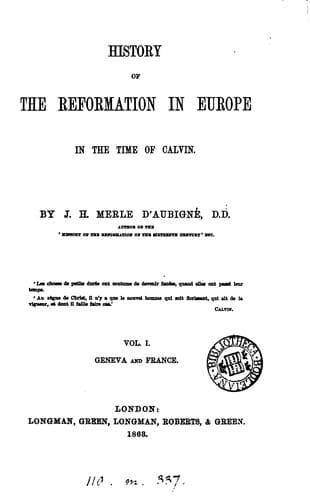
History of the Reformation in Europe in the Time of Calvin, Vol. 6 (of 8)Merle d'Aubigné, J. H. (Jean Henri)
History
History of the Reformation in Europe in the Time of Calvin, Vol. 6 (of 8)
Merle d'Aubigné, J. H. (Jean Henri)
Reformation
Among the Scottish people there were earnest aspirations after the
Gospel: but in that country, as in France, the priesthood and the
government forcibly repressed them. The more the state separated itself
from the pope in the south of Britain, the more it clung to him in
the north. The king, now become the direct instrument of the clergy,
required the parliament to check the progress which the Bible seemed to
be making in Scotland; and on June 8 this body, adding severity to the
former laws, enacted that whosoever possessed a New Testament should
deliver it to his bishop under pain of confiscation and imprisonment,
and that all _discussion_ about _religious opinions_ was prohibited.
It gave permission, however, to _clerks of the schools to read that
book, in order that they might the more efficiently contend against
its adherents_. Many priests, monks, and students therefore read the
New Testament; but this reading produced a quite contrary effect, for
it led them to receive and to defend the Gospel. This could not but
irritate the king and his priests, and make them feel still more the
necessity of an alliance with some ultramontane power. The conversion
of a Churchman who, through his family, was connected with the court,
especially attracted their attention.
[Sidenote: THOMAS FORREST.]
In a small island in the Firth of Forth, not far from Edinburgh,
stood the ancient abbey of St. Colme, occupied by Augustinian canons.
Distinguished among them was the son of the master of the stables
to King James IV. His name was Thomas Forrest, and he is not to be
confounded with the Benedictine, Henry Forrest, of whom we have already
spoken. A quarrel had broken out between the abbot and the canons;
the latter, in order to support their claims, seized the deeds of
foundation of the monastery. The abbot came in, scolded them sharply,
recovered the volume, and gave them in its place an old folio of St.
Augustine. The canons scornfully turned their backs on the book and
went back to their cells.
Forrest, left alone, looked at the volume. A work of the great
Augustine interested him. He took it into his cell, read it, and
ere long was able to say, with the bishop of Hippo--‘That which the
dispensation of works commands, is accomplished by the dispensation of
grace. O happy and blessed book!’ he would often say, ‘God has made
use of thee to enlighten my soul.’[189] St. Augustine led Forrest to
the Gospel, and he was not long in making known to his brethren the
treasure which he had found in the writings of this Father and in the
New Testament. Aged men stopped their ears. ‘Alas,’ said the son of the
king’s master-stabler, ‘the _old_ bottles will not receive the _new_
wine.’[190] The old canons complained to the abbot, and the abbot said
to Forrest, ‘Look after your own salvation, but talk as other men do.’
Public-domain text, read in full here on John Shaqi.
Reviews
Reviews
No reviews yet
Be the first to share your thoughts on this work.
Elsewhere in the archive
Join the Discussion
Join the discussion
Sign in to leave a comment or review.
Sign InorCreate an account