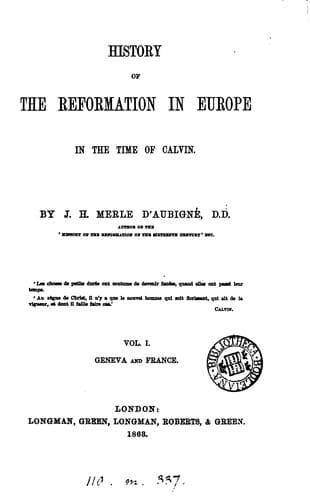
History of the Reformation in Europe in the Time of Calvin, Vol. 8 (of 8)Merle d'Aubigné, J. H. (Jean Henri)
History
History of the Reformation in Europe in the Time of Calvin, Vol. 8 (of 8)
Merle d'Aubigné, J. H. (Jean Henri)
Reformation
The times of the Reformation abound in martyrs; and we might well ask
whether primitive Christianity, which came to an end when the reign
of Constantine began, had so great a number of them as the renovated
Christianity of the sixteenth century; especially if we take into
account the different length of the periods. The impulse which led
the martyrs of the Netherlands, of France, England, Hungary, Italy,
Spain, and other lands to give up their lives calmly and even joyfully,
proceeded from the depth of their convictions, the holy and sovereign
voice of conscience, enlightened, purified, and strengthened by the
word of God. In the souls of these lowly heroes there was a secret and
mighty testimony to the truth of the Gospel which vividly manifested
to them its grandeur, impelled them to sacrifice all for its sake, and
gave them courage to obey, although it cost them not only goods and
worldly greatness, but also the good opinion, the affection and esteem
even of those whom they most tenderly loved. Obedience, indeed, was
not always instantaneous. Sometimes there were hindrances, conflicts,
hesitation, and delay. There were also some weak consciences which
were overcome. But wherever the conscience was sound, it acquired in
the midst of difficulties more and more force, and when once its
voice was heard the victory was won. It must be understood that we
do not mean here a conscience which a man has made for himself; that
of which we speak was the highest expression of truth, justice, and
the divine will, and it was found to be the same in all regions. The
souls of these martyrs were exempt from all prejudices, pure as a
cloudless sky. They were conscientious men; and herein we have the
complete explanation of the grand phenomenon presented to us in the
Reformation. Here was a force sufficient to break through stubborn
bonds, to surmount passionate opposition, to brave torture, and to go
to the stake. No concessions were to be made, no agreement with error.
The noble martyrs of the first centuries and of the sixteenth were the
select spirits and the glory of the human race.
[Sidenote: ITS RESULT.]
The death of San Romano was not fruitless. The saying current in the
first centuries was once more verified,--the blood of the martyrs is
the seed of the church. His faith, his renunciation of the world, his
courage at the stake, his rejoicing at the near approach of death,
deeply affected such of the spectators as had a conscience not yet
seared. The evangelicals of Valladolid, who had hardly avowed their
convictions except to their most intimate friends, were emboldened.
They expressed their sympathy with the martyr, and zeal and decision
took the place of timidity and lukewarmness. No church, however, was
formed in Valladolid till some years afterwards.
CHAPTER VII.
QUEEN JOANNA.
(BORN 1479; DIED 1555.)
Public-domain text, read in full here on John Shaqi.
Reviews
Reviews
No reviews yet
Be the first to share your thoughts on this work.
Elsewhere in the archive
Join the Discussion
Join the discussion
Sign in to leave a comment or review.
Sign InorCreate an account